Have you ever walked into a crowded market, a surprise party gone wild, or even a busy school hallway and thought, “Wow, this is pure pandemonium!”?
If so, you’re already using the word correctly—even if you didn’t realize it. Pandemonium isn’t just a fancy word; it captures moments of chaos, uproar, and wild energy that can happen anywhere, anytime.
In simple terms, pandemonium means a state of complete disorder or confusion. But like many words, its meaning is richer than just a dictionary definition.
Understanding this term helps us describe moments that are messy, loud, and unpredictable—but often memorable too.
From social events to workplace chaos, grasping this word allows you to express intense experiences more vividly.
In this article, we’ll dive into the real meaning of pandemonium, its origin, how it shows up in daily life, and why understanding it can make your communication more powerful.
By the end, you’ll not only know the word inside out but also be able to use it confidently in everyday conversations.
What Does Pandemonium Mean?
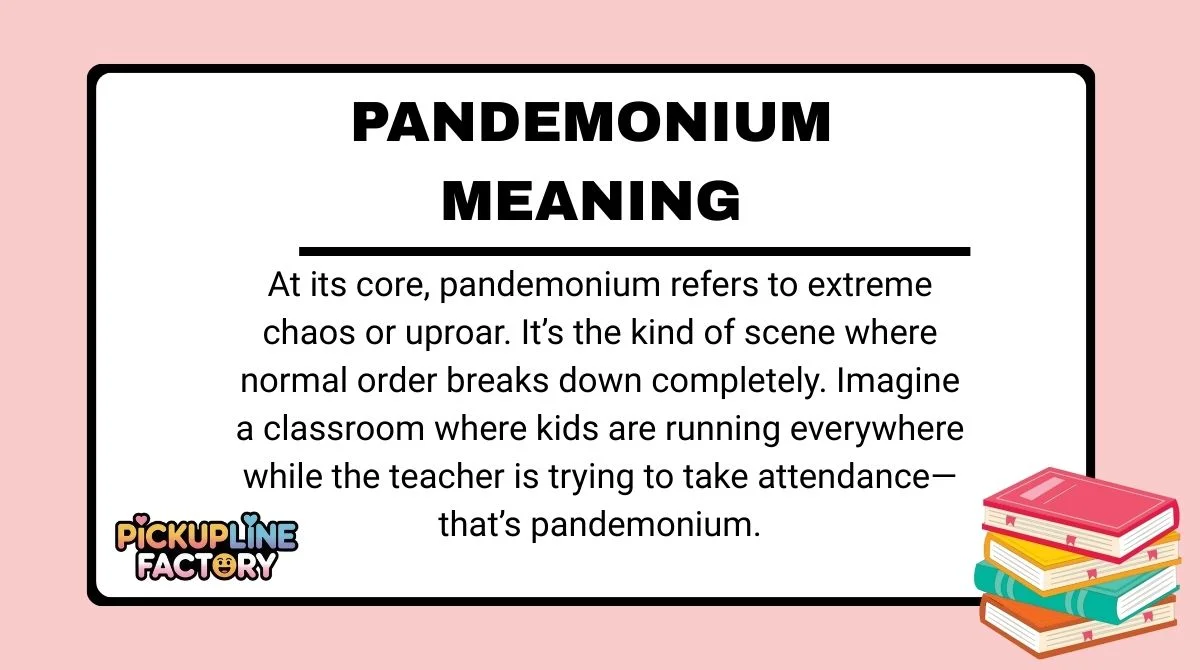
At its core, pandemonium refers to extreme chaos or uproar. It’s the kind of scene where normal order breaks down completely. Imagine a classroom where kids are running everywhere while the teacher is trying to take attendance—that’s pandemonium.
It’s not just about noise; it’s about a mixture of confusion, commotion, and unpredictability. Here are a few real-life examples:
- A concert where thousands of fans are cheering, jumping, and waving their hands in excitement.
- A family reunion that unexpectedly turns into a playful, loud pillow fight.
- Traffic after a sudden downpour, where drivers are honking and pedestrians are dodging puddles.
In each case, the common thread is chaotic energy—sometimes fun, sometimes stressful, but always unforgettable.
Origin and Background of the Term
The word pandemonium has a fascinating history. It was first coined by John Milton in his 1667 epic poem Paradise Lost. Milton used it as the name for the capital of Hell, a place where all demons gather—a fitting metaphor for total disorder.
Over time, the word left its literary roots and entered everyday language. By the 18th century, people were using pandemonium to describe any chaotic scene, whether at a market, a party, or a political protest. Today, it’s a colorful, expressive way to talk about disorder that’s dramatic but not always dangerous.
Knowing its origin adds depth and flair when using the word, making it more than just a synonym for chaos.
Pandemonium Meaning in English
The word pandemonium in English refers to a state of complete chaos, disorder, or wild uproar. It is often used when a place becomes extremely noisy, confusing, or out of control. For instance, if a crowd suddenly starts shouting, running, or reacting loudly, that situation can be described as pandemonium. The term carries a strong sense of intensity and is more impactful than simply saying “confusion” or “noise.”
Originally, pandemonium comes from literature and was used to describe a place full of chaos, almost like a scene of total disorder. Over time, it became a common English word used in everyday situations. Whether it’s a busy market, a sports event, or a sudden unexpected moment, the word helps express strong emotions and vivid imagery. Understanding the meaning of pandemonium allows you to communicate more clearly and adds a dramatic touch to your writing and speech.
How Pandemonium Is Used in Daily Life
Pandemonium isn’t limited to literature or history—it’s everywhere in modern life. Here are some practical examples:
- Traffic jams: A sudden accident can cause pandemonium on the highway.
- Sporting events: Fans celebrating a last-minute goal often create delightful pandemonium.
- Festivals and parades: Large crowds, music, and costumes contribute to an organized chaos that’s fun and lively.
- Office mishaps: Imagine a printer breaking during a deadline—papers flying, phones ringing—pure pandemonium.
- Unexpected emergencies: A fire drill or sudden alarm can create a brief but intense moment of pandemonium.
By observing these everyday situations, you’ll notice that pandemonium is more about the human reaction to chaos than the chaos itself.
Emotional or Practical Meaning of Pandemonium
Why does pandemonium matter emotionally? Because it represents moments when life feels larger than life. Chaos can be stressful, but it can also bring people together, spark creativity, and create memorable experiences.
Culturally, pandemonium is often associated with celebrations or dramatic moments—think of a carnival, a political rally, or a music festival. Psychologically, it taps into our natural response to disorder, triggering adrenaline, laughter, or teamwork as we navigate unpredictable situations.
In essence, pandemonium reflects both the unpredictability of life and our ability to adapt, enjoy, or survive it.
Similar or Related Terms
Here are a few words related to pandemonium and how they differ:
- Chaos: General lack of order; can be more negative.
- Uproar: Often louder and more vocal; usually involves reactions from people.
- Bedlam: Historically linked to a chaotic asylum; now means wild confusion.
- Mayhem: Often implies violent or destructive chaos.
- Havoc: Focuses on damage caused during disorder.
Each term has its nuance, but pandemonium uniquely combines noise, confusion, and lively energy.
Common Misunderstandings About Pandemonium
- It only refers to negative situations: Not true! Pandemonium can be exciting or fun.
- It’s formal or academic: Actually, it’s conversational and expressive.
- It implies violence: While it can, often it’s just noise and confusion.
- It’s old-fashioned: It’s still widely used today in media and casual speech.
- It’s synonymous with chaos: Close, but chaos is broader, while pandemonium has an emotional punch.
By clearing up these misconceptions, you can use the word more confidently.
Examples of Pandemonium in Sentences
- When the final whistle blew, pandemonium erupted in the stadium.
- There was absolute pandemonium in the kitchen when the cake collapsed.
- The surprise flash mob caused pandemonium in the shopping mall.
- A sudden power outage led to pandemonium at the office.
- Pandemonium broke out as the celebrity walked into the restaurant.
- During the sale, pandemonium filled the store as shoppers rushed the aisles.
- The puppy parade created delightful pandemonium in the park.
These examples show how versatile and lively the word can be.
Why Understanding Pandemonium Matters Today
In our fast-paced, unpredictable world, knowing words like pandemonium helps us communicate clearly and colorfully. It captures emotions, energy, and scenes that simpler words cannot.
Whether you’re writing, speaking, or sharing stories online, using precise, expressive language makes your communication more engaging. Pandemonium is a word that reminds us of life’s messy beauty and the excitement of the unexpected.
Pandemonium in a Sentence
The word pandemonium is often used to describe situations filled with extreme chaos, noise, or confusion. When you use “pandemonium” in a sentence, it helps paint a vivid picture of disorder or wild excitement. For example, imagine a crowded stadium where a last-minute goal is scored—the cheering, shouting, and excitement can easily be described as pandemonium. Similarly, a classroom can turn into pandemonium when students become overly excited or restless.
Using pandemonium in sentences adds depth and energy to your language. Instead of saying “there was a lot of noise,” you can say “the room erupted into pandemonium,” which sounds more expressive and powerful. It’s commonly used in storytelling, news reports, and everyday conversations to highlight intense situations. By practicing different sentence examples, you can naturally improve your vocabulary and make your communication more engaging and descriptive.
Bestow Synonym

The word bestow means to give, present, grant, or confer something as a gift, honor, or privilege. Depending on the context, several synonyms can replace bestow while keeping the sentence natural and meaningful. Common synonyms include grant, present, award, confer, donate, offer, give, provide, hand over, and gift. For example, an organization may bestow an award on a deserving employee, but you could also say it grants, presents, or confers the award. When referring to charitable acts, words like donate or give are often better choices. Choosing the right synonym depends on the situation, whether it involves formal recognition, generosity, or simply giving something to another person. Understanding these alternatives helps improve your vocabulary and allows you to express ideas more clearly in both everyday conversations and professional writing.
Frequently Asked Questions
What does pandemonium mean in simple words?
It means extreme chaos, noise, or confusion—when things are out of control.
Is pandemonium positive or negative?
It can be both. It often depends on context: exciting events vs. stressful situations.
Where is pandemonium commonly used?
In everyday conversations, media, literature, and social events.
Is pandemonium formal or informal?
It’s generally informal and expressive, perfect for storytelling or casual writing.
Why do people search for pandemonium?
Because it’s a vivid word to describe chaotic moments or high-energy experiences.
Conclusion
Pandemonium isn’t just a word—it’s a lens through which we can see life’s chaos, energy, and surprises.
From parties to traffic jams, understanding and using this term adds color and emotion to our language.
So next time life gets messy, loud, or unpredictable, remember: it might just be a moment of pure pandemonium—embrace it!
Life’s chaos isn’t something to fear; it’s something to experience fully and laugh about along the way.

Happy is a passionate content creator and blogger who loves sharing creative ideas, meaningful words, and trending content with readers worldwide.With a simple writing style and fresh perspective, Happy aims to make every article engaging, helpful, and enjoyable to read.