Have you ever looked up at the sky and witnessed the moon partially cover the sun, or seen the sun disappear behind the moon, leaving a surreal glow in the sky?
That magical, breathtaking moment is called an eclipse. But beyond the beauty, what does eclipse really mean? Is it just an astronomical event, or does it carry deeper significance in culture, language, and daily life?
Understanding eclipses isn’t just for scientists or sky-watchers. It’s about appreciating the balance of light and shadow, recognizing nature’s patterns, and even learning how humans throughout history interpreted this rare event.
In this article, we’ll dive deep into the eclipse meaning, explore its origins, practical applications, cultural impact, and even the common misconceptions that surround it.
By the end, you’ll not only understand eclipses better but also see why this celestial event has fascinated humanity for centuries.
What Does Eclipse Mean?
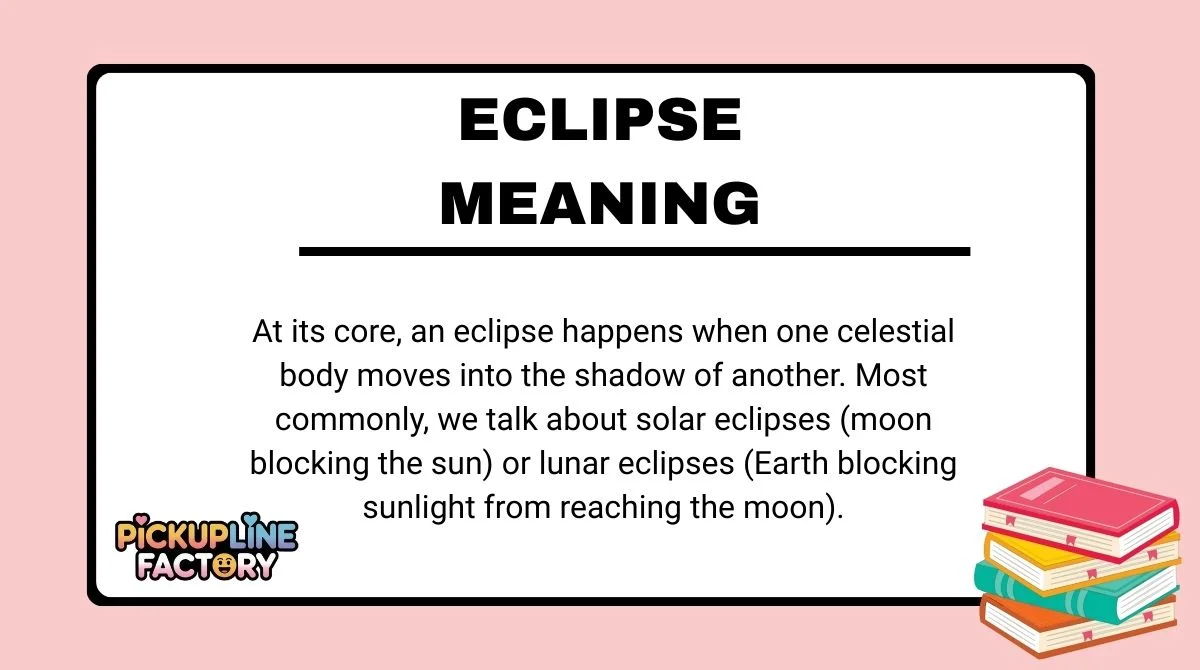
At its core, an eclipse happens when one celestial body moves into the shadow of another. Most commonly, we talk about solar eclipses (moon blocking the sun) or lunar eclipses (Earth blocking sunlight from reaching the moon).
But the meaning of an eclipse goes beyond astronomy. Figuratively, it refers to something being overshadowed or obscured, often by something else more powerful or prominent. For example:
- A new product eclipsed the popularity of its predecessor.
- His achievements were eclipsed by his sister’s fame.
- A moment of doubt eclipsed her confidence temporarily.
In essence, an eclipse is both a literal and metaphorical moment of hidden brilliance, where light and shadow interact in a fascinating dance.
Origin and Background of the Term
The word “eclipse” comes from the Greek word “ékleipsis,” meaning “to fail” or “abandon.” Ancient civilizations saw eclipses as omens, often linking them to gods, fate, or major worldly events.
In Babylonian times, eclipses were meticulously recorded to predict celestial events. The Greeks, on the other hand, were among the first to explain eclipses scientifically, realizing that the sun, moon, and Earth’s positions caused the temporary disappearance of light.
Storytelling example: Imagine being in 400 BCE, standing on a hill, watching the sky darken. People around you gasp, fearing catastrophe. A priest declares it a warning from the gods, while a curious astronomer quietly observes patterns in the sky. That contrast between fear and curiosity captures the timeless human fascination with eclipses.
How Eclipse Is Used in Daily Life
Eclipse isn’t just about the sky. It sneaks into our language, habits, and metaphors:
- In conversations: “Her talent eclipsed all expectations.”
- In literature: Writers use eclipses to symbolize change, mystery, or revelation.
- In media: Headlines like “Team A eclipses Team B” make comparisons vivid.
- In relationships: Saying someone’s charm eclipses another’s highlights emotional emphasis.
- In psychology: Feeling overshadowed by someone’s presence can be described as being eclipsed.
- In motivation: Overcoming obstacles can feel like emerging from an eclipse, stepping back into the light.
Emotional or Practical Meaning of Eclipse
Eclipses carry more than scientific weight—they resonate emotionally and culturally. They remind us that everything has cycles, periods of darkness followed by light. For centuries, eclipses symbolized transformation, renewal, and reflection.
In modern life, the eclipse metaphor often represents personal growth:
- Experiencing a setback can eclipse your confidence, but it’s temporary.
- Big achievements sometimes eclipse smaller wins, teaching humility.
- Collective events like solar eclipses create shared awe, connecting people across cultures.
An eclipse shows us that darkness isn’t permanent—it’s a precursor to light and understanding.
Similar or Related Terms
Here are a few words often related to “eclipse”:
- Occultation: Astronomical term for when one body hides another.
- Shadowing: Metaphorical or literal covering of one thing by another.
- Overshadow: Figurative—when something dominates or diminishes another.
- Obscuration: The state of being hidden or blocked.
- Solar/Lunar Phenomenon: Specific types of eclipses in astronomy.
Each term has subtle differences but connects back to the core idea: temporary hiding or dominance.
Common Misunderstandings About Eclipse
- Eclipses are rare: Actually, solar and lunar eclipses happen multiple times a year, but total solar eclipses are rarer for any specific location.
- Eclipses cause disasters: Ancient myths feared doom, but scientifically, they’re harmless.
- You can safely watch without protection: Only lunar eclipses are safe; solar eclipses require eye protection.
- Eclipses are only solar: Lunar eclipses are just as fascinating and visible to many more people.
- Eclipse affects behavior or luck: While symbolic, no evidence suggests it physically changes human behavior.
Examples of Eclipse in Sentences
- The moon eclipsed the sun, leaving a glowing ring in the sky.
- Her latest book eclipsed all her previous publications in popularity.
- Darkness eclipsed the valley before dawn broke.
- His sudden fame eclipsed his humble beginnings.
- A solar eclipse captivated the crowd in awe.
- Anxiety sometimes eclipses rational thinking.
- The athlete’s performance was eclipsed by a record-breaking teammate.
- Watching the lunar eclipse, we felt a rare sense of cosmic connection.
Why Understanding Eclipse Matters Today
Eclipses remind us of the beauty of cycles, the balance between light and dark, and the fleeting nature of events. They inspire science, art, literature, and philosophy. Understanding eclipses encourages:
- Curiosity: Pushing us to explore the universe.
- Perspective: Recognizing our place in the cosmic scale.
- Connection: Shared experiences of awe build cultural and emotional bridges.
- Reflection: Using the eclipse metaphor in personal growth, motivation, and learning.
In a world that often moves too fast, acknowledging moments of darkness and light—literal or figurative—keeps us grounded and inspired.
Frequently Asked Questions
What does eclipse mean in simple words?
It’s when one object blocks another, like the moon covering the sun, or figuratively when something is overshadowed.
Is eclipse positive or negative?
It can be both—literally neutral in astronomy, but metaphorically it can signify temporary hiding or being overshadowed.
Where is eclipse commonly used?
In astronomy, literature, daily language, and metaphors for life events or achievements.
Is eclipse formal or informal?
It’s versatile—used formally in science and informally in conversation or writing.
Why do people search for eclipse?
Curiosity about astronomical events, metaphorical usage, cultural significance, or planning to witness a solar or lunar eclipse.
Conclusion
Eclipses are more than a stunning celestial show; they’re a symbol of life’s cycles, moments of pause, and opportunities to reflect.
Whether you’re gazing at the sky or using the term in daily life, understanding eclipse meaning gives you a deeper appreciation for both nature and human expression.
Remember: even when something seems to overshadow you, like an eclipse, light will always return—bringing clarity, growth, and new beginnings. 🌞🌙