Have you ever been wronged, insulted, or treated unfairly and didn’t know how to respond? Maybe someone cut you off in traffic, took credit for your work, or said something hurtful.
Instead of reacting angrily, what if you simply “turned the other cheek”?
The phrase “turn the other cheek” isn’t just a religious saying—it’s a timeless idea about responding to conflict with patience, dignity, and emotional intelligence.
At first, it might sound like letting people walk over you, but it’s actually about choosing your response and protecting your peace.
Understanding this phrase can help you navigate relationships, workplace tensions, and even everyday annoyances with grace.
By the end of this article, you’ll not only grasp the real meaning of this concept, but you’ll also learn how to apply it practically in daily life, avoid common misconceptions, and see its emotional and social significance today.
What Does Turn the Other Cheek Mean?
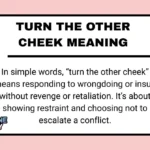
In simple words, “turn the other cheek” means responding to wrongdoing or insult without revenge or retaliation. It’s about showing restraint and choosing not to escalate a conflict.
Think of it like this: someone pushes you, and instead of pushing back, you remain calm and collected. That doesn’t mean you’re weak—it shows strength, self-control, and emotional maturity.
Real-life examples:
- Your coworker criticizes your idea in a meeting. Instead of snapping back, you thank them for their feedback and continue presenting confidently.
- A friend makes a sarcastic comment that hurts your feelings. Instead of arguing, you smile and move on, keeping the friendship intact.
- Someone spreads a rumor about you. You choose not to confront them aggressively, focusing on your own reputation and actions.
In all these examples, turning the other cheek is about choosing peace over conflict, even when it’s difficult.
Origin and Background of the Term
The phrase “turn the other cheek” originates from the Bible, specifically the Sermon on the Mount in the Gospel of Matthew (Matthew 5:39). Jesus taught his followers to respond to aggression without revenge: “But I tell you, do not resist an evil person. If anyone slaps you on the right cheek, turn to them the other cheek also.”
Historically, this was revolutionary. In a world dominated by honor, retaliation, and physical punishment, choosing non-violence required immense courage. It was less about passivity and more about moral strength.
Over time, the phrase has transcended religious texts and entered everyday language. Philosophers, writers, and leaders have used it to promote peaceful resistance, forgiveness, and emotional control. Think of Gandhi’s nonviolent movement or Martin Luther King Jr.’s philosophy—they both embody the spirit of turning the other cheek in the modern world.
How Turn the Other Cheek Is Used in Daily Life
Turning the other cheek isn’t limited to spiritual texts—it’s a practical tool for everyday life. Here are some ways people use it:
- At work: Your colleague takes credit for your idea. Instead of yelling, you address the situation calmly later.
- In traffic: Someone cuts you off. You resist honking or road rage and keep driving peacefully.
- With friends: A friend forgets your birthday. You acknowledge your feelings but don’t retaliate with passive aggression.
- Online interactions: You receive a rude comment on social media. Instead of replying angrily, you ignore it or respond politely.
- Family dynamics: A family member criticizes your life choices. You listen, stay composed, and don’t argue.
- Customer service: A client complains rudely. You remain professional and polite, diffusing tension.
The common thread? Choosing your response intentionally rather than reacting impulsively.
Emotional or Practical Meaning of Turn the Other Cheek
Turning the other cheek is more than just a phrase—it’s a psychological strategy. It helps reduce stress, prevent conflicts from escalating, and promotes emotional resilience.
Culturally, it teaches humility, forgiveness, and patience. Socially, it can improve relationships, create harmony, and even protect your reputation. People respect those who handle conflict gracefully.
Modern life is full of minor injustices, online trolling, and workplace drama. Choosing non-retaliation doesn’t make you weak—it demonstrates strength of character and self-control.
Similar or Related Terms
- Let it go: Release anger or resentment without confrontation.
- Forgive and forget: Forgive someone and move on without holding grudges.
- Keep your cool: Stay calm under provocation.
- Rise above: Don’t stoop to negativity.
- Kill them with kindness: Respond to hostility with friendliness.
Each of these phrases emphasizes peaceful response, though some focus more on emotion while others on action.
Common Misunderstandings About Turn the Other Cheek
- It means being weak: Not true. It’s about strength and control, not submission.
- You have to accept abuse: No, it’s about responding thoughtfully, not tolerating harm.
- It’s outdated: The principle is timeless and applicable today in personal and professional life.
- It’s only religious: It’s a universal concept found in ethics, psychology, and philosophy.
- It means doing nothing: Actually, it’s a conscious action—choosing restraint over reaction.
- It guarantees peace: It helps reduce conflict, but others may still act negatively. The goal is your own response and peace of mind.
Examples of Turn the Other Cheek in Sentences
- When Jenna criticized my work unfairly, I turned the other cheek and focused on improving my skills.
- He insulted me in public, but I smiled and turned the other cheek.
- Instead of arguing back, I chose to turn the other cheek and walked away.
- She spread rumors, but I turned the other cheek and ignored it.
- I could have yelled at the rude driver, but I turned the other cheek.
- My teammate sabotaged my project, and I decided to turn the other cheek.
- Even though I was hurt, I turned the other cheek for the sake of our friendship.
- Online trolls were relentless, but I turned the other cheek and posted a positive comment instead.
Why Understanding Turn the Other Cheek Matters Today
In today’s fast-paced, reactive world, understanding this principle is more valuable than ever. It helps us:
- Maintain mental health: Avoid unnecessary anger and stress.
- Improve relationships: Handle disagreements with dignity.
- Exhibit leadership: Leaders who turn the other cheek inspire respect.
- Navigate modern conflicts: From social media to workplace disputes, it promotes calm and thoughtful responses.
By embracing this mindset, you empower yourself to live peacefully, even in challenging situations.
Frequently Asked Questions
What does turn the other cheek mean in simple words?
It means responding to wrongdoing without revenge, choosing patience and emotional control over retaliation.
Is turn the other cheek positive or negative?
It’s positive, demonstrating strength, dignity, and self-control.
Where is turn the other cheek commonly used?
It’s used in religious texts, psychology, everyday speech, and conflict resolution discussions.
Is turn the other cheek formal or informal?
It can be used in both formal and informal contexts, depending on the situation.
Why do people search for turn the other cheek?
People want to learn peaceful ways to handle conflict, improve relationships, and manage emotions effectively.
Conclusion
Turning the other cheek is not about weakness—it’s about choosing peace over anger, dignity over revenge, and strength over impulsivity.
By embracing this approach, you can handle life’s conflicts with grace, improve your relationships, and maintain your emotional well-being.
Remember: choosing calm over confrontation isn’t giving up—it’s winning the inner battle. Start small, practice patience, and watch how it transforms your interactions and your life.