Have you ever noticed that rough patch of skin that forms over a cut or scrape and wondered what it’s actually called?
Or maybe you’ve heard the word “scab” used in a workplace argument or a story and weren’t sure what it meant in that context.
The term “scab” might seem simple at first, but it has multiple layers—literally and figuratively!
Understanding it can help you in everyday conversation, writing, and even in grasping historical or cultural references.
Whether you’re reading a novel, listening to someone at work, or caring for a minor injury, knowing the meaning of “scab” gives you more clarity.
In this article, we’ll break down the term in simple words, explore its origins, share practical examples, clear up common misconceptions, and even give you tips for using it correctly in daily life.
By the end, you’ll not only know what a scab is but also why it matters.
What Does Scab Mean?
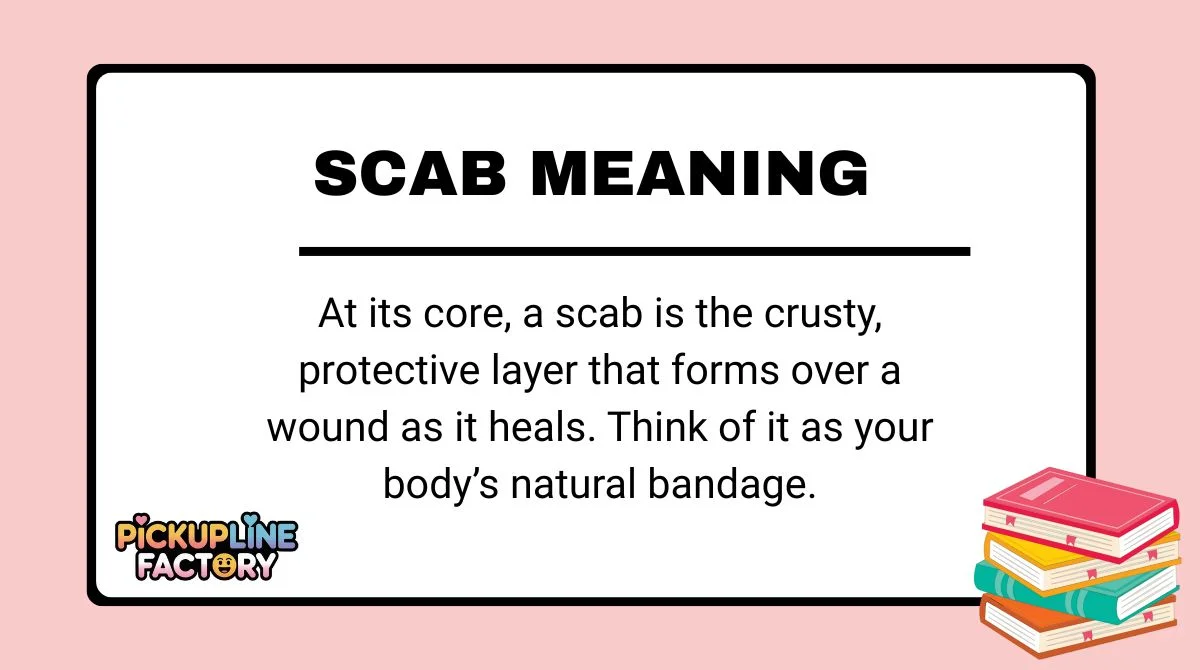
At its core, a scab is the crusty, protective layer that forms over a wound as it heals. Think of it as your body’s natural bandage. Without a scab, cuts and scrapes would take longer to recover and could be prone to infection.
But there’s more! In social or workplace contexts, “scab” can also refer to someone who crosses a picket line during a strike—basically, a person who works when others are protesting or striking.
Examples in real life:
- You scrape your knee while riding a bike, and the skin hardens into a brownish scab.
- During a workers’ strike, a colleague continues working, and fellow employees call them a “scab” (metaphorically).
- A character in a novel refuses to join a rebellion and is labeled as a scab by others.
So, one word can describe both healing skin and a social role, depending on context.
Origin and Background of the Term
The word “scab” has an interesting history. Its roots go back to Old Norse “skabb”, which meant something like “diseased skin” or “dermatological problem.” Over time, it evolved in Middle English to describe the hard crust that forms over wounds.
By the 19th century, labor movements adopted the term metaphorically to refer to strikebreakers—workers who refused to join strikes or replaced striking employees. This gave the word a charged social and cultural meaning, often associated with betrayal or lack of solidarity.
Imagine this: in 1800s England, workers would see someone crossing the picket line and shout, “There goes the scab!” It wasn’t just about work—it was about loyalty, community, and values.
Scab Meaning (Slang)
In slang, the word scab can have several meanings depending on the context, but it is generally used in a negative or informal way. Outside of its original labor-related definition, scab is often used to describe someone who is unpleasant, annoying, or untrustworthy. It can also refer to a person who takes advantage of others or behaves in a rude or inconsiderate manner.
In some casual conversations, especially among younger speakers, scab may be used as a light insult, though it still carries a slightly harsh tone. For example, someone might call another person a scab if they act unfairly or don’t follow group expectations. However, the intensity of the word can vary depending on tone and situation.
Because slang evolves quickly, the meaning of scab can shift across regions and communities. Still, it usually retains its core idea of negativity or disapproval. Using it carefully is important, as it can easily come across as offensive if misunderstood.
How Scab Is Used in Daily Life
The word “scab” pops up more often than you might think. Here are some practical ways people use it today:
- Medical context: “Don’t pick that scab; it’ll slow down your healing.”
- Workplace: “He’s a scab for showing up while everyone else is striking.”
- Writing/Storytelling: “The old warrior’s arm was covered with scabs from countless battles.”
- Metaphorical advice: “Stop letting small problems become scabs on your mental health.”
- Parenting tip: “Teach your kids not to pick scabs—they heal faster if left alone.”
Notice how the tone changes depending on the context. Sometimes it’s neutral, sometimes negative, and occasionally even educational.
Emotional or Practical Meaning of Scab
Why does the word “scab” matter emotionally?
- Medical healing: It’s a reminder that wounds need care and patience. Seeing a scab can signal recovery and resilience.
- Social impact: Calling someone a “scab” in labor disputes carries strong emotional weight, often highlighting betrayal or moral conflict.
- Cultural significance: In literature and media, scabs can symbolize hardship, perseverance, or even the scars of past decisions.
Understanding both meanings helps you read people, books, and situations more accurately.
Similar or Related Terms
- Crust: A general layer over a wound, not necessarily protective.
- Pus: Fluid from an infected wound—different from a healthy scab.
- Pick: To remove a scab, often slowing healing.
- Strikebreaker: The labor term equivalent of a social “scab.”
- Healing: The process associated with scab formation.
Each term has its nuances, but all are connected to health, recovery, or social dynamics.
Common Misunderstandings About Scab
- “Scabs are bad for healing.” – False. They protect wounds and aid recovery.
- “All scabs are visible immediately.” – False. Sometimes scabs form under the skin or hair.
- “Calling someone a scab is medical.” – False. In social contexts, it’s metaphorical.
- “Scabs are dirty.” – Not necessarily. They’re natural protective layers.
- “You must always remove a scab.” – False. Picking a scab slows healing.
- “Only old wounds get scabs.” – False. Even minor cuts form scabs.
Clearing up these misconceptions helps prevent pain, confusion, or social mistakes.
Examples of Scab in Sentences
- “After falling off her bike, a scab formed on her elbow within hours.”
- “He refused to join the strike and was labeled a scab by his coworkers.”
- “The novel described the soldier’s face covered in scabs from previous battles.”
- “Mom told me not to pick my scabs or they’d leave scars.”
- “Workers shouted at the scab who replaced them during the protest.”
- “Tiny scabs formed on the plant after pruning damaged its leaves.”
- “She gently cleaned the scab before putting on a new bandage.”
- “The term ‘scab’ in that poem symbolized betrayal and isolation.”
Why Understanding Scab Matters Today
In today’s world, “scab” is more than just a skin term. It connects biology, history, and social dynamics. By knowing the word:
- You communicate more clearly in conversations or writing.
- You understand literature, media, and social movements better.
- You connect health knowledge with practical advice for yourself and others.
Plus, it’s a great reminder that even small things, like a scab, carry deeper meaning—about healing, loyalty, and resilience.
Scab Meaning (Person)
The term scab when used to describe a person has a specific and often negative meaning, especially in work and labor contexts. Traditionally, a scab is someone who continues to work or accepts employment during a strike, crossing picket lines while others protest for better wages or conditions. Because of this, the word carries a strong sense of disapproval and is often used by workers or unions to describe someone seen as disloyal or unsupportive.
Beyond labor disputes, calling someone a “scab” can also imply selfishness or a lack of solidarity with a group. It suggests that the person is prioritizing their own benefit over collective effort. However, it’s important to understand the context before using the term, as it can be considered harsh or offensive.
In modern usage, the meaning still largely revolves around betrayal or breaking unity, making it a powerful but sensitive word. Knowing its background helps you use it appropriately and avoid misunderstandings in conversation.
Scab Meaning Slang
In slang, scab is a strong and often insulting term used to describe someone who is seen as betraying a group, refusing to support others, or acting only in their own interest. The word is most commonly associated with workplace disputes, where it refers to a person who continues working during a strike instead of joining the workers who are protesting. Because of this history, calling someone a scab usually carries a negative meaning and suggests disloyalty or a lack of solidarity. In modern conversations, especially online or in casual discussions, the term can also be used more broadly to criticize someone who breaks an agreement, ignores team efforts, or benefits while others make sacrifices. However, its exact meaning depends on the context, and it should be used carefully because many people consider it offensive. Understanding the scab meaning in slang helps you recognize why the word appears in conversations about work, politics, sports, and social issues, where loyalty and cooperation are often important themes.
Frequently Asked Questions
What does scab mean in simple words?
A scab is the hard layer that forms over a wound to protect it while it heals. It can also refer to someone who works during a strike.
Is scab positive or negative?
Medically, it’s neutral or positive (healing). Socially, it’s negative (betrayal in labor disputes).
Where is scab commonly used?
In medical contexts, workplaces, literature, and daily conversation.
Is scab formal or informal?
Informal in social contexts, neutral in medical contexts.
Why do people search for scab?
To understand healing, social dynamics, literature, or historical usage.
Conclusion
Whether you’re examining a scraped knee or reading about labor strikes, understanding scab meaning gives you clarity, context, and insight.
Remember: a scab isn’t just a crust—it’s a symbol of healing, protection, and sometimes social judgment.
Next time you see one, appreciate the story it tells, both on skin and in society. And always remember: even small signs of healing or resilience matter in life.

Happy is a passionate content creator and blogger who loves sharing creative ideas, meaningful words, and trending content with readers worldwide.With a simple writing style and fresh perspective, Happy aims to make every article engaging, helpful, and enjoyable to read.