Have you ever noticed a clever word puzzle in a poem or a message where the first letters spell out a secret word?
That’s called an acrostic, and it’s more than just a fun writing trick—it’s a way to express creativity, emotion, and meaning through letters.
Whether it’s in school projects, birthday cards, or even poetry shared on social media, acrostics have a fascinating charm that makes words come alive.
Understanding the acrostic meaning isn’t just for writers or teachers—it’s for anyone curious about how language can hold hidden messages.
By learning what acrostics are, their origins, and how they’re used, you can unlock a world of playful communication and creative expression.
Let’s dive into this captivating form of word art and explore why it continues to inspire people of all ages.
What Does Acrostic Mean?
An acrostic is a type of writing in which the first letter, syllable, or word of each line or paragraph spells out a message or word. It’s like a secret code hidden in plain sight. The idea is simple: read vertically, and you uncover a hidden meaning.
Examples in real life:
- Names in poems: Writing a poem where the first letters of each line spell someone’s name.
- Motivational messages: Creating acrostics where each line starts with letters forming “HOPE” or “LOVE.”
- Educational tools: Teachers use acrostics to help students remember concepts, like ROYGBIV for the colors of the rainbow.
Essentially, acrostics combine creativity with utility, making learning, writing, or even greeting cards more engaging.
Origin and Background of the Term
The concept of acrostics is centuries old. The term comes from the Greek word “akrostichis,” meaning “the first letters of the line.” Ancient Greeks used acrostics in poetry to encode messages or honor important people.
Over time, acrostics appeared in religious texts, including early Hebrew manuscripts where sacred words were hidden in lines of scripture. Medieval poets then adopted the technique to honor royalty or convey secret messages, especially when literacy rates were low.
Storytelling through acrostics became a playful and meaningful way to communicate ideas covertly. Today, while the context is more casual, the principle remains: hiding meaning inside letters adds depth and intrigue to writing.
Acrostic Meaning and Examples
The term acrostic refers to a creative form of writing where certain letters—usually the first letters of each line—combine to form a word or phrase. Acrostics are often seen in poetry, school assignments, greeting cards, and word games because they make writing more interactive and visually interesting. This style encourages creativity while helping readers notice hidden meanings within the text.
Here is a simple example using the word “STAR”:
Shine brightly every day
Trust your inner strength
Always follow your dreams
Reach for success
In this example, the first letters spell the word “STAR.” Acrostics can be short and simple or detailed and emotional depending on the writer’s purpose. They are commonly used by students learning English, poets creating artistic work, and teachers making lessons more engaging.
People enjoy acrostics because they are easy to understand yet highly creative. They transform ordinary words into meaningful pieces of writing and help readers connect with language in a fun and memorable way.
How Acrostic Is Used in Daily Life
Acrostics aren’t just for history books—they appear in modern life everywhere:
- School projects: Kids create acrostics for vocabulary words or names.
- Birthday or greeting cards: Messages like “HAPPY” spelled vertically with lines describing the recipient.
- Poetry: Writers craft acrostics to embed subtle themes or words.
- Social media captions: Hidden messages or jokes for followers to discover.
- Marketing slogans: Brands sometimes use acrostics to make memorable campaigns.
- Memory aids: Students use acrostics like “PEMDAS” for math order of operations.
In short, acrostics are everywhere if you know what to look for—they’re a fun mix of education, art, and communication.
Emotional or Practical Meaning of Acrostics
Acrostics aren’t just a clever literary tool—they carry emotional significance. A simple acrostic can make someone feel special because it’s personalized. Think about receiving a poem where your name is spelled out vertically, with each line describing your personality—instantly, it becomes more than words; it’s an expression of thoughtfulness.
Practically, acrostics aid memory, learning, and creativity. They encourage critical thinking and challenge writers to convey meaning within constraints, making language learning fun and interactive.
Similar or Related Terms
- Palindrome: Reads the same forward and backward. Unlike acrostics, it focuses on symmetry.
- Cryptogram: Encodes messages using a cipher. Acrostics hide messages in plain sight.
- Mnemonic: Helps memory but may not form a full poem or sentence.
- Backronym: Creating a phrase to fit an existing word. Related but often humorous.
- Alliteration: Repeating sounds in words; decorative, unlike the hidden structure of acrostics.
Common Misunderstandings About Acrostics
- Acrostics are only for children. False—they’re used in literature, marketing, and poetry.
- They always spell names. Not true; they can convey any word or message.
- Acrostics are complicated. Actually, simple vertical messages work perfectly.
- They must rhyme. No—rhyming is optional.
- They’re outdated. Modern texting, social media, and creative writing keep them alive.
- Only first letters count. Some acrostics use syllables or entire words for vertical messages.
Examples of Acrostics in Sentences
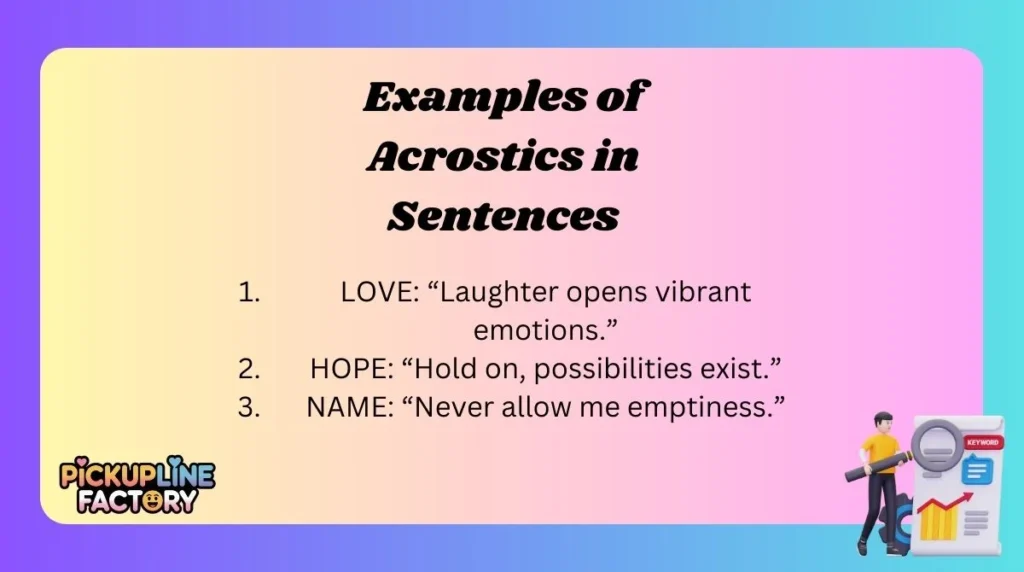
- LOVE: “Laughter opens vibrant emotions.”
- HOPE: “Hold on, possibilities exist.”
- NAME: “Never allow me emptiness.”
- FRIEND: “Forever relying in every new day.”
- SUN: “Shining upon nature.”
- RAIN: “Refreshing and inspiring naturally.”
- JOY: “Jump over yesterday.”
- PEACE: “People embracing all calm energy.”
These examples show how acrostics make words memorable, creative, and meaningful.
Why Understanding Acrostic Matters Today
In a digital world, we often skim content. Understanding acrostics teaches us to look deeper, appreciate subtlety, and engage creativity. They’re also tools for education, communication, and emotional expression, giving a personal touch to everyday interactions.
Acrostics remind us that words aren’t just functional—they’re playful, expressive, and powerful. Whether for learning, gifting, or self-expression, they make language more alive and interactive.
Acrostic Meaning in English
An acrostic is a type of writing in which the first letter of each line, word, or paragraph forms a hidden word, message, or pattern when read vertically. It is commonly used in poetry, creative writing, puzzles, and educational activities to make language more engaging and memorable. In simple terms, an acrostic turns ordinary writing into something clever and meaningful by hiding a message within the text itself.
For example, if the first letters of four lines spell the word “LOVE,” the poem becomes an acrostic poem. This writing style has been used for centuries in literature, religious texts, and even modern social media content. Teachers often use acrostics to help students learn vocabulary or remember concepts in a fun way.
Acrostics are popular because they combine creativity with structure. They allow writers to express ideas while adding an extra layer of meaning for readers to discover. Whether used in poems, names, motivational words, or artistic projects, acrostics continue to be a simple yet powerful form of expression in English writing.
Frequently Asked Questions
What does acrostic mean in simple words?
An acrostic is a writing style where the first letters of lines spell a word or message. Think of it as a secret vertical message.
Is acrostic positive or negative?
Acrostics are neutral—they can be used for positive, humorous, or even serious messages depending on context.
Where is acrostic commonly used?
In poems, school assignments, greeting cards, and social media captions—anywhere words can carry hidden meaning.
Is acrostic formal or informal?
It can be both. Formal poetry and religious texts use acrostics, while casual cards or social posts use them informally.
Why do people search for acrostic meaning?
Many seek it for creative writing, educational purposes, and fun communication. Understanding acrostics helps make writing more engaging.
Conclusion
Acrostics are more than just clever wordplay—they’re a bridge between creativity, learning, and personal expression.
From school projects to heartfelt poems, they show how much power letters hold when arranged thoughtfully.
Next time you write a message or a poem, try hiding a word in plain sight—you might discover just how magical words can be. ✨
Remember: even small gestures, like a hidden acrostic, can make someone’s day brighter and show the depth of your creativity.

Happy is a passionate content creator and blogger who loves sharing creative ideas, meaningful words, and trending content with readers worldwide.With a simple writing style and fresh perspective, Happy aims to make every article engaging, helpful, and enjoyable to read.