Have you ever heard someone say, “The crown will decide” or “Hollywood is obsessed with sequels” and wondered why they didn’t just say the king or the movie industry?
That’s where metonymy comes in. It’s a literary tool that lets us refer to something indirectly, using a word closely related to it.
Understanding metonymy can make your writing more vivid, your speech more engaging, and even your daily conversations sharper.
Metonymy isn’t just for poets or writers—it shows up everywhere, from news headlines to everyday chat.
Once you grasp its meaning and purpose, you’ll start noticing it all around you. By learning metonymy, you’re not just expanding your vocabulary—you’re learning a subtle way to convey complex ideas with fewer words.
In this article, we’ll explore the definition, examples, origins, and practical uses of metonymy so that you can use it like a pro.
What Does Metonymy Mean?
At its core, metonymy is a figure of speech where one word is substituted for another that’s closely connected. Unlike metaphors, which compare things, metonymy relies on association rather than similarity.
Think of it like a shortcut in language. Instead of saying “the government will decide,” you say “the crown will decide.” Here, “crown” represents authority or leadership.
Real-Life Examples
- The White House issued a statement – “White House” refers to the U.S. president or administration.
- Silicon Valley is innovating again – “Silicon Valley” stands for tech companies, not the actual valley.
- All hands on deck – “Hands” represent people.
By using metonymy, language becomes more colorful, efficient, and memorable.
Origin and Background of the Term
The word “metonymy” comes from the Greek metōnymía, which means “a change of name.” Ancient Greeks loved exploring how words could represent ideas indirectly. Philosophers and writers like Aristotle discussed metonymy as a tool to make speech more persuasive and elegant.
Over time, metonymy spread through Latin and eventually into English literature. Shakespeare often used metonymy to add subtlety and flair. For example, when he wrote “The crown hath power,” he was using a word closely tied to authority instead of explicitly naming the king.
In short, metonymy has deep roots in history and has shaped how humans communicate abstract or complex ideas efficiently.
How Metonymy Is Used in Daily Life
Metonymy isn’t just for literature—it’s everywhere. Here are some practical examples:
- Business news: “Wall Street reacted negatively” → Wall Street = financial industry.
- Sports commentary: “The bench cheered loudly” → bench = substitute players.
- Social media: “Instagram is flooded with memes” → Instagram = its users.
- Casual conversation: “Can you pass me a Kleenex?” → Kleenex = any tissue.
- Politics: “Downing Street announced a plan” → Downing Street = UK government.
- Everyday humor: “The suits are here” → suits = corporate executives.
These examples show that metonymy makes language punchy, relatable, and fun.
Emotional or Practical Meaning of Metonymy
Metonymy isn’t just stylistic—it shapes perception. Using a word like “the crown” instead of “the king” evokes respect, authority, or tradition. Saying “Hollywood loves sequels” is punchier than “the movie industry loves sequels”.
In modern culture, metonymy allows us to compress ideas and convey emotion. Advertisers, journalists, and storytellers rely on it to connect with audiences quickly. Recognizing metonymy also helps us decode messages in media and politics, giving us sharper insight into language.
Similar or Related Terms
- Synecdoche: A part represents the whole, e.g., “all hands on deck.”
- Metaphor: Comparison based on similarity, e.g., “Time is a thief.”
- Symbolism: Objects or images represent broader ideas, e.g., a dove = peace.
- Allusion: Indirect reference to literature, history, or culture.
- Euphemism: Polite expression for something unpleasant, e.g., “passed away” = died.
Difference: Metonymy relies on association, not similarity or symbolism.
Common Misunderstandings About Metonymy
- It’s the same as a metaphor – Wrong. Metaphors compare; metonymy substitutes.
- Only for literature – Nope. It’s everywhere, from news to chat.
- It’s too fancy or complex – Actually, we use it daily without realizing.
- It changes the meaning completely – It enhances clarity or style, not confuses.
- It’s outdated – Far from it! Modern advertising, media, and memes rely on it.
- Only nouns can be metonyms – Mostly nouns, but sometimes verbs/adjectives in creative contexts.
Examples of Metonymy in Sentences
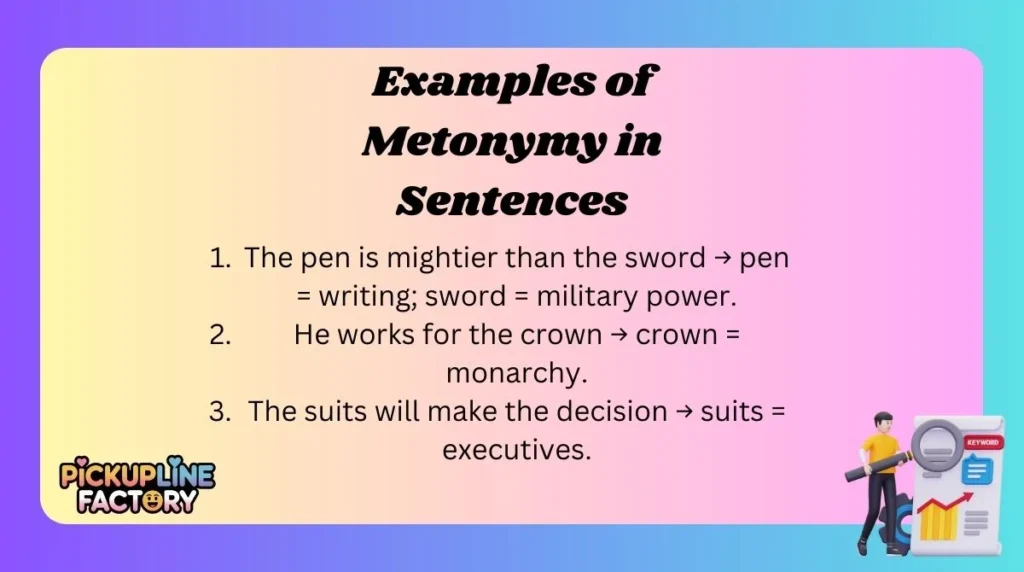
- The pen is mightier than the sword → pen = writing; sword = military power.
- He works for the crown → crown = monarchy.
- The suits will make the decision → suits = executives.
- Hollywood is producing another hit → Hollywood = film industry.
- All hands on deck → hands = people.
- The White House denied the claim → White House = U.S. government.
- Silicon Valley is leading innovation → Silicon Valley = tech companies.
- She borrowed a Kleenex → Kleenex = tissue.
Why Understanding Metonymy Matters Today
In today’s fast-paced digital world, knowing metonymy helps in multiple ways:
- Better writing: Your emails, articles, and social posts become sharper.
- Enhanced communication: Speak indirectly yet clearly, capturing attention.
- Media literacy: Decode hidden meanings in news and ads.
- Creative storytelling: Add depth to characters and plots effortlessly.
Metonymy allows language to carry emotion, authority, or humor with fewer words—a skill that is invaluable in modern communication.
Frequently Asked Questions
What does metonymy mean in simple words?
It’s when you use one word to represent something closely related, like “crown” for a king.
Is metonymy positive or negative?
It’s neutral; it depends on the context and how it’s used.
Where is metonymy commonly used?
Literature, journalism, advertising, politics, and everyday speech.
Is metonymy formal or informal?
Both! It appears in casual chat and professional writing alike.
Why do people search for metonymy?
To improve writing, understand language better, or decode media and literature.
Conclusion
Metonymy is more than a literary trick—it’s a powerful tool that shapes how we think, speak, and understand the world.
By mastering it, you can make your communication more vivid, persuasive, and memorable. Next time you say “The crown will decide,” remember: you’re not just talking—you’re painting a picture with words.
Embrace the subtle art of metonymy, and watch ordinary speech turn into extraordinary expression.