Have you ever wondered what the word “warren” truly means? Maybe you’ve come across it in books, movies, or even in conversations, and it piqued your curiosity.
At first glance, it might seem simple, but warren carries more depth than most people realize.
Whether it’s used literally to describe a physical place or metaphorically to explain a complex situation, understanding this word can add nuance to your speech and writing.
In today’s world, where language evolves constantly, knowing the origins and modern usage of words like warren helps us communicate clearly and connect more meaningfully.
From cozy rabbit homes to dense city neighborhoods, warren conveys ideas of structure, complexity, and even security.
By the end of this article, you’ll not only know what warren means, but also how to use it in daily life with confidence, clarity, and even a touch of style.
What Does Warren Mean?
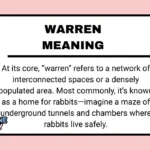
At its core, “warren” refers to a network of interconnected spaces or a densely populated area. Most commonly, it’s known as a home for rabbits—imagine a maze of underground tunnels and chambers where rabbits live safely. That’s the literal sense.
But in a more figurative sense, warren can describe a crowded or intricate place, like a busy city street, a packed office, or even a cluttered house. It’s a way to convey complexity, busyness, or tight-knit spaces in just one word.
Real-life examples:
- The old apartment building was a warren of tiny rooms and narrow hallways, yet everyone felt at home.
- The city’s underground subway system is a warren of tunnels, with commuters flowing in every direction.
- Her grandmother’s attic was a warren of forgotten treasures, each corner holding a story.
Origin and Background of the Term
The word warren dates back to the Middle Ages, originating from the Old French word warenne, meaning an enclosed area for breeding rabbits. At the time, rabbits were valuable for both food and fur, and these enclosed areas were carefully monitored.
Over the centuries, the term gradually evolved. Writers began using “warren” metaphorically to describe complex, crowded places—think medieval towns with twisting alleyways or labyrinthine buildings. Literature and poetry embraced the imagery of warrens to describe intricacy, safety, or confinement.
Interestingly, some regions even used warren to refer to hunting grounds or private lands. Today, the word carries both its historical charm and modern versatility, bridging the literal and figurative worlds.
How Warren Is Used in Daily Life
You might not think about it, but “warren” pops up in everyday language more than you’d expect. Here are some practical examples:
- Home décor: “The attic is a warren of old trunks and forgotten furniture.”
- Urban life: “The downtown district is a warren of alleyways and cafes.”
- Workspaces: “Our office feels like a warren of cubicles, each buzzing with activity.”
- Nature: “The rabbits disappeared into their underground warren.”
- Storytelling: “Her mind was a warren of ideas, constantly moving and shifting.”
- Travel descriptions: “We got lost in the warren of streets in Venice, but it was part of the charm.”
In each scenario, warren conveys complexity, interconnectedness, and a sense of depth, making it a useful word in writing and speech.
Emotional or Practical Meaning of Warren
Beyond physical spaces, warren can also symbolize security, intimacy, and belonging. Rabbits build warrens for safety, and humans often create their own versions—a cozy home, a trusted friend circle, or even a private hobby space.
Culturally, the word reminds us that complexity doesn’t have to be chaotic. A bustling city or a crowded office can feel like a warren—full of life, stories, and opportunities, if we take the time to explore it.
On a personal level, calling a place or space a warren often evokes comfort and familiarity, even if it’s crowded or confusing. It’s the kind of word that adds emotion and texture to everyday life.
Similar or Related Terms
Here are some words related to warren, with clear differences:
- Maze – focuses more on complexity and puzzling layout.
- Labyrinth – emphasizes confusing or intricate pathways, often metaphorical.
- Burrow – specifically an underground hole, usually for animals.
- Haven – a safe or cozy space, less about complexity.
- Nest – emphasizes comfort and security, usually smaller scale.
- Network – highlights interconnectedness rather than physical space.
Common Misunderstandings About Warren
- It only refers to rabbits – While originally about rabbit homes, it now also describes human spaces.
- It implies chaos – Warrens are complex but can be organized and functional.
- It’s an outdated word – Modern literature, urban descriptions, and casual speech still use it.
- It’s only physical – Warren can also be used metaphorically for ideas, thoughts, or online networks.
- It’s negative – Not necessarily; it can evoke warmth, safety, or charm.
- It’s formal language only – Informal use works in stories, blogs, and even conversations.
Examples of Warren in Sentences
- The market was a warren of stalls, each offering unique treasures.
- Her childhood home was a warren of rooms and secret corners.
- The rabbits disappeared into their warren under the old oak tree.
- The novel describes the city as a warren of narrow alleys and hidden courtyards.
- The office had become a warren of cubicles, buzzing with activity.
- His thoughts were a warren of memories and ideas, impossible to untangle.
- We wandered through the warren of streets, discovering new cafés at every turn.
- The abandoned castle was a warren of tunnels and chambers, full of mystery.
Why Understanding Warren Matters Today
In today’s fast-paced world, understanding words like warren helps us communicate clearly and creatively. Whether describing a city, a home, or even our mental spaces, it allows us to capture intricacy, intimacy, and structure in a single term.
For writers, bloggers, and storytellers, it adds color and emotion to descriptions. For everyday speakers, it provides a precise way to describe crowded or complex areas without sounding vague. Embracing words like warren bridges history, language, and modern life, enriching our conversations and storytelling.
Frequently Asked Questions
What does warren mean in simple words?
A warren is a network of small spaces—like tunnels, rooms, or crowded areas. Literally for rabbits, figuratively for humans too.
Is warren positive or negative?
It can be both, depending on context. A rabbit warren is safe; a crowded office warren might feel hectic.
Where is warren commonly used?
In literature, urban descriptions, storytelling, and casual speech. Writers love it for its imagery.
Is warren formal or informal?
It works in both formal and informal contexts, making it versatile.
Why do people search for warren?
People want to understand its meaning, history, and usage, especially when reading books, articles, or poems.
Conclusion
The word warren is much more than just a rabbit home. It’s a symbol of complexity, safety, and interconnectedness, weaving together literal and metaphorical meanings.
By understanding it, you gain a word that can enrich your writing, storytelling, and everyday conversations.
So next time you explore a bustling city, a cozy home, or even your own thoughts, remember: life itself can be a beautiful warren, full of twists, turns, and hidden treasures.
Embrace it, explore it, and let every corner tell a story.