GMT is one of those abbreviations that can confuse people because it has more than one meaning depending on where and how it is used.
In most formal settings, GMT stands for Greenwich Mean Time, which is a global time standard used to coordinate clocks around the world.
However, in texting, chat apps, and social media, people sometimes use abbreviations in creative or informal ways, which leads many users to search for “what does GMT mean in text.”
The reason this term is commonly searched is because users see it in messages, timestamps, or conversations and are unsure whether it refers to time zones or a slang expression.
Since digital communication often shortens words into acronyms, understanding GMT becomes important for correctly interpreting messages.
This article explains the meaning of GMT in different contexts, how it is used in online conversations, and how it changes depending on situation and platform.
Meaning & Definition
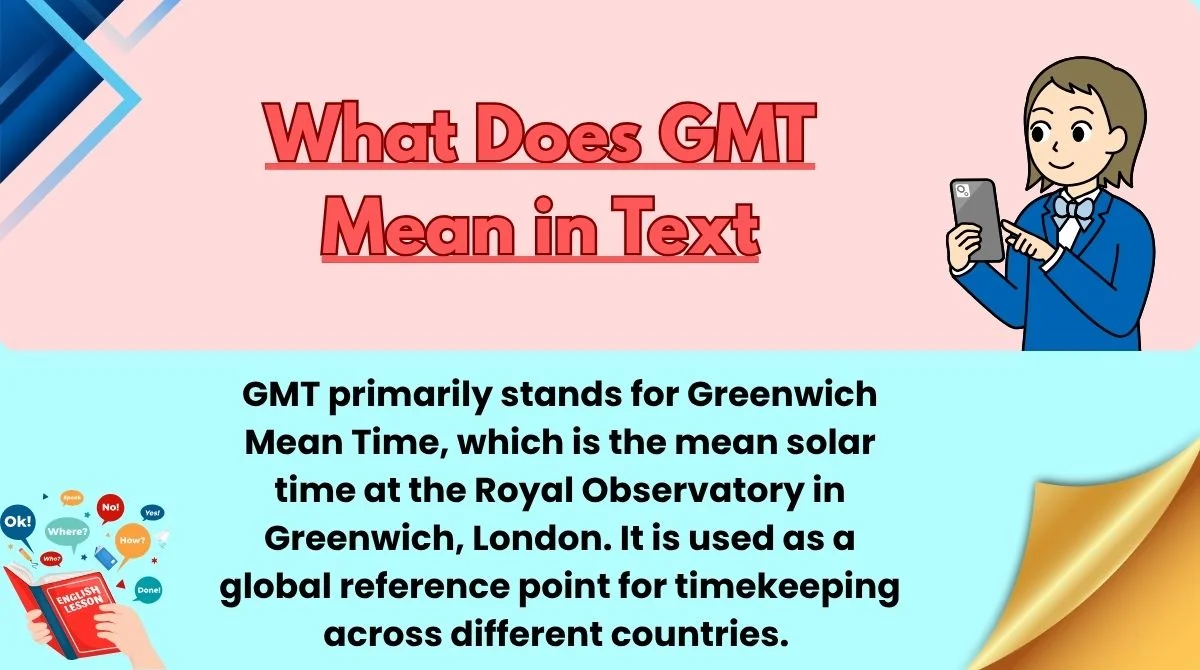
GMT primarily stands for Greenwich Mean Time, which is the mean solar time at the Royal Observatory in Greenwich, London. It is used as a global reference point for timekeeping across different countries. Many international systems, aviation schedules, and scientific calculations rely on GMT to maintain consistency.
In texting or informal communication, however, GMT does not have a widely accepted slang meaning like some other acronyms (e.g., LOL or BRB). Instead, when it appears in chats, it usually still refers to time. For example, someone might say “Let’s meet at 5 PM GMT,” meaning the meeting time is based on the Greenwich time zone.
Sometimes users mistakenly assume GMT has a hidden or trendy slang meaning in chat culture. In reality, its meaning remains mostly unchanged even in digital communication. The confusion arises because modern messaging platforms often mix formal abbreviations with informal slang, making users think every acronym has multiple interpretations.
So, the correct understanding is:
- Formal meaning: Greenwich Mean Time (time zone reference)
- Informal usage: Still refers to time, not slang
Understanding this helps avoid misinterpretation in conversations, especially in global or international discussions.
Background
The concept of GMT dates back to the 19th century when global travel and communication required a standard time reference. The Royal Observatory in Greenwich, England, was chosen as the prime meridian (0° longitude), making it the starting point for global time zones.
Before GMT, different cities used local solar time, which created confusion in transportation and communication, especially with the rise of railways. GMT solved this by offering a unified reference time.
Over time, GMT became essential in:
- Shipping navigation
- Aviation scheduling
- Military coordination
- International communication systems
Although today UTC (Coordinated Universal Time) is more precise and commonly used in science, GMT is still widely recognized and used in everyday contexts.
In digital communication, GMT appears in timestamps on emails, social media posts, and messaging apps when showing when a message was sent across different time zones. This is why people often encounter it in chats and search its meaning.
The background of GMT shows that it is not just an abbreviation but a foundational concept in global timekeeping.
Usage in Different Contexts (Chat, Social Media, Professional Fields)
GMT appears in several communication environments, but its meaning remains mostly consistent.
In chat and messaging apps, GMT is often used when people from different countries are talking about meeting times. For example:
- “I’ll call you at 8 PM GMT”
In social media platforms like Instagram, Facebook, and TikTok, GMT may appear in post timestamps or scheduling tools. Content creators sometimes schedule posts based on GMT to reach a global audience at the same time.
In professional fields, GMT is extremely important:
- In business meetings across countries
- In aviation flight schedules
- In international broadcasting
- In military operations
For example, airlines often list departure times in GMT or UTC to avoid confusion across countries.
Unlike slang abbreviations, GMT does not change meaning depending on tone or platform. Whether it appears in a casual chat or a formal document, it always refers to time coordination.
Meaning in Chat, WhatsApp, Instagram, TikTok
On platforms like WhatsApp, Instagram, and TikTok, GMT is most commonly seen in timestamps or scheduling references.
In WhatsApp chats, users might use GMT when talking to someone in another country:
- “Reply me at 6 PM GMT please”
On Instagram, GMT may appear in analytics tools that show when followers are active in different time zones. Influencers use it to schedule posts for maximum engagement.
On TikTok, creators sometimes refer to GMT when planning global live streams or uploads, ensuring viewers from different regions can join at the same time.
Importantly, GMT is not a slang word in these apps. It is not used to express emotions, reactions, or informal meanings. Instead, it is purely time-related.
People sometimes confuse GMT with internet slang, but it does not function like terms such as “LOL,” “BTW,” or “IDK.” Its role remains technical, even in casual environments.
Meaning in Physics, Medical, and Aircraft Terminology
In scientific and technical fields, GMT plays a more structured role.
In physics and astronomy, GMT is used as a reference time system for experiments, observations, and data logging. Scientists often need a universal time standard to ensure accuracy in global research.
In the medical field, GMT is not commonly used as a medical term itself, but hospitals and research studies may use it to record patient data across different time zones in international studies.
In aviation terminology, GMT is extremely important. Flight schedules, air traffic control, and navigation systems often rely on GMT or UTC to coordinate flights across countries. For example:
- Departure: 14:00 GMT
- Arrival: 20:00 GMT
This ensures pilots and air traffic controllers avoid confusion caused by local time differences.
Overall, GMT in technical fields represents precision, coordination, and global standardization.
Common Misconceptions
One of the biggest misconceptions is that GMT is a slang abbreviation used in texting culture. In reality, this is incorrect. GMT is not like modern internet slang.
Other common misunderstandings include:
- Thinking GMT has a hidden emotional meaning in chats
- Assuming GMT changes meaning across apps
- Confusing GMT with similar abbreviations like “GTM”
Another misconception is that GMT is outdated because of UTC. While UTC is more precise, GMT is still widely used and understood globally.
Some people also think GMT is only relevant to the UK, but it is actually a global reference system used everywhere.
Understanding these misconceptions helps users correctly interpret messages and avoid confusion.
Similar Terms & Alternatives
GMT is often confused with or related to several similar terms:
- UTC (Coordinated Universal Time): The modern standard used in science and technology
- EST (Eastern Standard Time): Time zone used in parts of North America
- PST (Pacific Standard Time): Used on the west coast of the USA
- IST (Indian Standard Time): Time zone used in India
While GMT is a reference point, other time zones are calculated relative to it.
In texting contexts, there are no true “slang alternatives” to GMT because it is not slang. However, people may simply say:
- “local time”
- “your time”
- “my time”
These alternatives help avoid confusion when chatting internationally.
How to Respond to It
If someone mentions GMT in a conversation, your response depends on context.
If it refers to time:
- Confirm the time difference
- Convert it to your local time
Example: “Okay, that’s 10 PM my time.”
If you are unsure:
- Ask clarification: “Do you mean GMT time zone?”
In professional settings, always confirm scheduling carefully to avoid mistakes.
In casual chats, acknowledging GMT simply means understanding the time reference without overthinking it.
Differences from Similar Words (≈250–500 words)
GMT is often confused with other abbreviations, but it is distinct:
- GMT vs UTC: GMT is older and based on solar time; UTC is more precise atomic time
- GMT vs slang acronyms: GMT is not emotional or conversational slang
- GMT vs local time zones: GMT is the reference point, not a regional time
This makes GMT unique because it is both historical and functional.
Relevance in Online Conversations & Dating Apps
In online conversations and dating apps, GMT is mostly used when people are in different countries and need to coordinate time for chatting, calls, or meetings.
For example:
- “I’m free at 7 PM GMT, what about you?”
It helps avoid confusion between different time zones.
In dating apps, especially international ones, GMT ensures both users understand when to connect, regardless of location.
It is not a romantic or slang expression, but a practical communication tool.
Conclusion
GMT, or Greenwich Mean Time, is a globally recognized time standard used in communication, science, aviation, and everyday digital interactions.
While some users search for its meaning in text thinking it might be slang, it remains a technical term related to time coordination.
In chats, WhatsApp, Instagram, and TikTok, GMT helps people from different regions schedule conversations and activities without confusion.
Its importance extends to professional fields like aviation and scientific research, where accuracy and synchronization are essential.
Understanding GMT allows users to interpret messages correctly and avoid misunderstandings in global communication.
Even though newer systems like UTC exist, GMT continues to be widely used and understood. Overall, GMT is not slang but a vital part of how the world stays connected across time zones.

Happy is a passionate content creator and blogger who loves sharing creative ideas, meaningful words, and trending content with readers worldwide.With a simple writing style and fresh perspective, Happy aims to make every article engaging, helpful, and enjoyable to read.