Have you ever come across the word “realm” and wondered what it truly means? Maybe you’ve read it in a fantasy novel, seen it in news articles, or even heard someone use it in a conversation about technology or social spaces.
While it might sound grandiose or mystical, the word is more common than you think—and it carries layers of meaning that can enrich how we talk about the world around us.
In simple terms, a realm refers to a domain, area, or space where someone has influence, control, or activity.
But it’s not just about literal territories; it can also describe abstract areas like ideas, skills, or communities.
Understanding what “realm” means can help you communicate more precisely, appreciate literature better, and even describe your personal or professional “kingdom” with flair.
In this article, we’ll explore realm meaning in detail, its origin, daily uses, emotional impact, and much more—so by the end, you’ll never read it the same way again.
What Does Realm Mean?
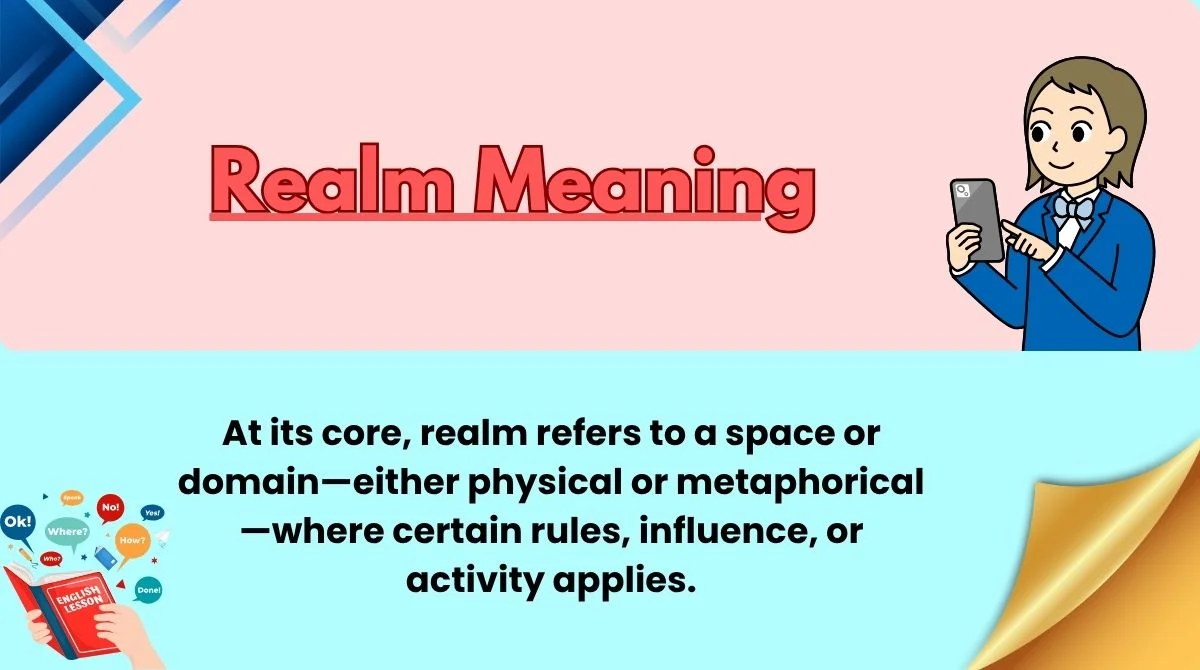
At its core, realm refers to a space or domain—either physical or metaphorical—where certain rules, influence, or activity applies. It’s like a stage where something or someone operates.
Here are a few real-life examples:
- Physical Realm: A king’s kingdom, a country, or any territorial domain.
- Professional Realm: “She excels in the realm of digital marketing,” meaning her skills dominate that area.
- Abstract Realm: “In the realm of imagination,” where ideas flow freely beyond the constraints of reality.
In everyday conversations, using “realm” adds depth and sophistication. It’s not just a fancy word; it’s a way to categorize influence and spaces, whether tangible or conceptual.
Origin and Background of the Term
The word realm comes from the Old French reaume and Latin regalis, meaning “royal” or “kingly.” Historically, it was used to describe territories ruled by monarchs—places where kings or queens had authority. Picture medieval Europe, with sprawling castles and banners waving over lands carefully managed by royalty—that was a realm in its truest sense.
Over time, the term expanded beyond literal kingdoms. Writers, thinkers, and scholars began using it to describe areas of thought, art, and influence. For example, the realm of philosophy or the realm of science highlights a domain where specific rules or expertise apply. This evolution shows how words can grow from concrete origins into flexible tools of expression.
How Realm Is Used in Daily Life
“Realm” isn’t just for novels or history books—it pops up in everyday life in ways you might not notice:
- Workplace: “He’s a leader in the realm of technology.”
- Education: “The professor introduced students to the realm of classical literature.”
- Gaming: “Enter the realm of Azeroth” (a common reference in online games).
- Personal Growth: “She explored the realm of mindfulness to reduce stress.”
- Science & Research: “This discovery opens a new realm in medical science.”
- Entertainment: Movies, books, or shows often describe magical worlds as realms, creating immersive experiences for audiences.
Using “realm” conveys authority, scope, and depth, making your speech or writing feel more precise and polished.
Emotional or Practical Meaning of Realm
Beyond literal definitions, “realm” carries emotional weight. It evokes feelings of possibility, exploration, and authority. When someone says, “I’ve entered the realm of creativity,” it suggests stepping into a space of freedom and potential.
Culturally, we also use it to highlight respect or admiration. For instance, acknowledging someone’s mastery in their field as a “realm” shows esteem for their expertise. On a personal level, thinking about your own “realms”—like family, work, or hobbies—helps structure priorities and clarify focus in life.
Similar or Related Terms
Here are terms related to realm, with subtle differences:
- Kingdom: Often literal; a realm ruled by a monarch.
- Domain: Emphasizes ownership or control, often in technical contexts.
- Sphere: More abstract; a sphere of influence or activity.
- Territory: Usually physical; land controlled or claimed.
- Province: Similar to territory, sometimes administrative.
- Universe: Broadest form; can imply all-encompassing space or scope.
While all these terms overlap with realm, realm uniquely balances literal and metaphorical usage.
Common Misunderstandings About Realm
- It only refers to medieval kingdoms. False—realms can be abstract.
- It’s an outdated term. Not at all; it’s still used in modern literature, tech, and business.
- Only for formal writing. Casual conversation can benefit too: “realm of friendship,” “realm of opportunity.”
- It’s synonymous with world. Close, but realm implies specific boundaries or focus.
- It always implies control. Not necessarily; it can just describe a space or domain.
- It’s pretentious. Used naturally, it enhances clarity and style rather than sounding pompous.
Examples of Realm in Sentences
- She is a genius in the realm of science fiction writing.
- The new game introduces players to a mysterious realm under the sea.
- Meditation allows you to enter the realm of inner peace.
- In the corporate realm, networking is key to success.
- Their discussion stayed within the realm of theoretical physics.
- The artist’s imagination opens a realm of endless possibilities.
- He prefers to live in the realm of simplicity, away from chaos.
- The conference explored the realm of artificial intelligence and its future impact.
Why Understanding Realm Matters Today
Understanding the meaning of realm is not just academic—it’s practical. In a world full of specialized fields, digital communities, and abstract spaces, knowing how to use “realm” helps you:
- Communicate clearly about expertise or influence
- Describe personal growth or exploration
- Enhance storytelling in writing, gaming, or media
- Show respect for someone’s skill or knowledge
In short, “realm” gives you a versatile word that bridges history, imagination, and modern relevance.
Frequently Asked Questions
What does realm mean in simple words?
A realm is a space, domain, or area where something exists or operates, either literally or metaphorically.
Is realm positive or negative?
It’s neutral. Its tone depends on context—can imply respect, creativity, or even challenge.
Where is realm commonly used?
In literature, gaming, business, education, and everyday conversation to describe domains of activity or influence.
Is realm formal or informal?
It can be both. Works well in casual speech, professional writing, and creative contexts.
Why do people search for realm?
To understand its meaning, use it in writing, or describe areas of expertise, influence, or imagination.
Conclusion
The word realm is far more than a fancy term—it’s a window into spaces of influence, creativity, and possibility.
From medieval kingdoms to personal growth, from abstract ideas to professional domains, understanding this word empowers your communication and storytelling.
Next time you use it, remember: you’re not just describing a place—you’re highlighting a space of potential, authority, and imagination. Step boldly into your own realms and embrace the opportunities they hold.

Happy is a passionate content creator and blogger who loves sharing creative ideas, meaningful words, and trending content with readers worldwide.With a simple writing style and fresh perspective, Happy aims to make every article engaging, helpful, and enjoyable to read.