If you spend time texting, chatting on social media, or browsing online conversations, you have probably come across the abbreviation NVM.
Many people see this short term in messages and wonder what it means, when it should be used, and whether it is appropriate in different situations.
Understanding common internet abbreviations has become increasingly important because digital communication relies heavily on quick and convenient expressions.
NVM is one of the most widely used texting shortcuts across messaging apps, social media platforms, online forums, and dating apps.
It helps people communicate faster while expressing a specific meaning in just three letters.
Although the term appears simple, its meaning can vary slightly depending on the context and the tone of the conversation.
In this guide, you will learn the complete meaning of NVM, its background, how it is used in text messages, social media, professional settings, and even its meanings in technical fields.
You will also discover common misconceptions, alternatives, and the best ways to respond when someone sends NVM in a conversation.
Meaning & Definition
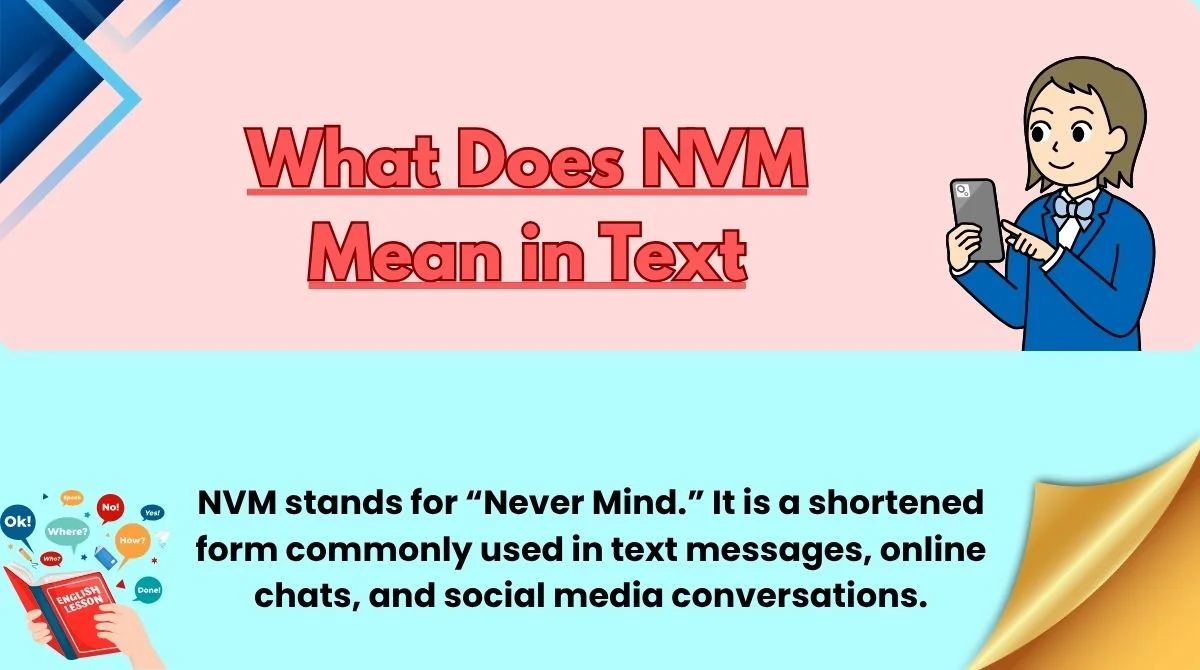
NVM stands for “Never Mind.” It is a shortened form commonly used in text messages, online chats, and social media conversations.
People typically use NVM when they want to:
- Withdraw a question
- Cancel a previous statement
- Indicate that something is no longer important
- Show that they have already found an answer
- End a topic without further discussion
For example:
Person A: What time does the meeting start?
Person B: Let me check.
Person A: NVM, I found the email.
In this example, Person A no longer needs an answer because they solved the issue themselves.
The abbreviation is popular because it saves time and allows users to communicate quickly. While NVM generally means “never mind,” the tone can change depending on the conversation. Sometimes it sounds casual and friendly, while other times it may appear dismissive or slightly frustrated.
Because of this, understanding the context is essential. In most cases, however, NVM is simply a convenient way to say that further explanation or discussion is unnecessary.
Background
The abbreviation NVM became popular during the early growth of internet communication and mobile texting. In the late 1990s and early 2000s, text messages often had character limits, encouraging users to shorten words and phrases whenever possible.
As online messaging evolved, people developed countless abbreviations such as:
- LOL (Laugh Out Loud)
- BRB (Be Right Back)
- BTW (By The Way)
- IMO (In My Opinion)
- NVM (Never Mind)
NVM quickly became a standard internet shorthand because it expressed a common conversational need. People frequently changed their minds, found answers independently, or wanted to move on from a topic. Using “Never Mind” repeatedly could feel unnecessary when three letters communicated the same message.
Over time, the abbreviation spread across forums, instant messaging platforms, gaming communities, and eventually social media networks. Today, NVM is recognized worldwide and is understood by most internet users regardless of age or location.
Despite the rise of new slang and internet expressions, NVM remains relevant because it serves a practical purpose. Unlike trendy phrases that come and go, this abbreviation continues to be useful in everyday digital communication.
Usage in Different Contexts
The meaning of NVM remains largely consistent, but its usage changes depending on the environment.
Casual Conversations
In personal chats, NVM is often used when someone no longer needs information.
Example:
“I figured it out. NVM.”
Social Media
Users may post NVM in comments or replies when they realize a misunderstanding or answer their own question.
Example:
“NVM, I just saw the update.”
Online Gaming
Gamers frequently use NVM during fast-paced discussions when strategies or questions become irrelevant.
Example:
“NVM, we already completed that mission.”
Workplace Communication
While NVM can appear in internal chats, professionals often prefer writing the complete phrase “Never mind” because it sounds more polished.
Example:
“Never mind, I located the document.”
Customer Support
Support teams may use the full phrase rather than the abbreviation to maintain professionalism and clarity.
In every setting, NVM generally communicates that a previous statement, request, or question no longer requires attention.
Meaning in Chat, WhatsApp, Instagram, and TikTok
Chat Messages
In regular texting, NVM is commonly used when the sender finds an answer independently.
Example:
“NVM, I figured it out.”
WhatsApp users frequently use NVM in personal conversations because it is quick and informal.
Example:
“NVM, I already called them.”
On Instagram, NVM often appears in comments, direct messages, or story replies.
Example:
“NVM, I just noticed the caption.”
TikTok
TikTok users may write NVM in comments after realizing a misunderstanding about a video.
Example:
“NVM, watched the full video and now it makes sense.”
Across all platforms, NVM serves the same basic purpose: indicating that a question, concern, or discussion is no longer necessary.
Meaning in Physics, Medical, and Aircraft Terminology
Although NVM usually means “Never Mind” online, abbreviations can have different meanings in specialized fields.
Physics
NVM is not a universally recognized standard abbreviation in physics. However, certain organizations or research documents may use it as an internal acronym with a specific technical meaning.
Medical Terminology
In healthcare environments, NVM may occasionally represent specialized medical terms depending on the institution or documentation system. Its meaning can vary and is not standardized across all medical fields.
Aircraft Terminology
In aviation, abbreviations are heavily regulated. NVM may sometimes appear as an organization-specific code or notation, but it is not commonly recognized by the public as a standard aviation abbreviation.
Because technical meanings differ across industries, context is critical when interpreting NVM outside everyday communication.
Common Misconceptions
Several misunderstandings surround the abbreviation NVM.
It Always Means Anger
Many people assume NVM indicates frustration or annoyance. While it can sometimes sound irritated, it often has a completely neutral meaning.
It Is Rude
NVM is not automatically rude. Tone depends on the conversation and relationship between participants.
It Is Only Used by Teenagers
Although younger generations frequently use internet slang, people of all ages use NVM in digital communication.
It Has Only One Meaning Everywhere
In technical fields and specialized industries, abbreviations can have alternative meanings. Context determines the correct interpretation.
Understanding these misconceptions helps avoid confusion during online conversations.
Similar Terms & Alternatives
Several expressions serve a purpose similar to NVM.
Never Mind
The complete version of NVM.
Forget It
Used when something no longer matters.
It’s Okay
Often used to reassure someone that no action is needed.
No Worries
A friendly alternative in casual conversations.
Disregard That
A more professional option often used in workplaces.
Ignore My Previous Message
Common in business communication when correcting an error.
Choosing the right alternative depends on the tone and formality of the conversation.
How to Respond to It
Responding to NVM is usually straightforward.
If the Issue Is Resolved
You can simply reply:
- “Okay.”
- “Got it.”
- “No problem.”
If You Want to Help
You might say:
- “Are you sure?”
- “Let me know if you still need assistance.”
In Professional Settings
Consider a polite response such as:
- “Understood.”
- “Thank you for the update.”
The best response depends on whether the conversation is casual, professional, or personal.
Differences from Similar Words
Although NVM resembles other expressions, important differences exist.
NVM vs OK
NVM ends a topic, while OK confirms understanding or agreement.
NVM vs Ignore
Ignore specifically requests that information be disregarded. NVM often indicates the issue has already been resolved.
NVM vs Forget It
Forget it can sound more emotional or frustrated, whereas NVM is usually neutral.
NVM vs No Problem
No problem reassures someone, while NVM withdraws a previous request or statement.
Recognizing these distinctions improves communication clarity.
Relevance in Online Conversations & Dating Apps
NVM remains highly relevant in modern online communication. Whether people are chatting on messaging apps, participating in social media discussions, or using dating platforms, quick communication is essential.
On dating apps, NVM is often used when someone realizes a misunderstanding or no longer needs clarification.
Examples include:
- “NVM, I saw it in your profile.”
- “NVM, you already answered my question.”
- “NVM, I figured it out.”
Because online conversations move quickly, abbreviations like NVM help users save time while keeping communication efficient.
However, users should be mindful of tone. Overusing NVM can sometimes make conversations feel abrupt or dismissive. Adding a friendly follow-up message can help maintain a positive interaction.
Overall, NVM continues to be one of the most recognized and practical abbreviations in digital communication.
Conclusion
NVM is a widely used abbreviation that stands for “Never Mind.” It plays an important role in modern digital communication by helping people quickly indicate that a question, request, or discussion is no longer necessary.
Whether used in text messages, WhatsApp chats, Instagram comments, TikTok discussions, gaming communities, or dating apps, the abbreviation provides a convenient and efficient way to communicate.
Although NVM usually has a simple meaning, context remains essential because tone and interpretation can vary depending on the conversation.
Understanding when to use it, how to respond to it, and how it differs from similar expressions can help improve communication and reduce misunderstandings.
As internet language continues to evolve, NVM remains a practical and recognizable abbreviation that bridges convenience and clarity.
Knowing its meaning allows users to navigate online conversations more confidently and communicate effectively across various digital platforms.

Happy is a passionate content creator and blogger who loves sharing creative ideas, meaningful words, and trending content with readers worldwide.With a simple writing style and fresh perspective, Happy aims to make every article engaging, helpful, and enjoyable to read.