Have you ever been chatting with someone online and suddenly received the message “ACC”? If you paused for a moment wondering what it meant, you’re definitely not alone.
The internet is filled with abbreviations that can make conversations faster, but they can also leave people confused if they’re unfamiliar with them.
Understanding what does ACC mean in text is useful because the meaning often depends on the conversation and the platform where it’s used. In most texting situations, ACC commonly stands for “Actually”, helping people respond quickly without typing the entire word. However, it can also have different meanings in gaming, business, education, and social media.
In this guide, you’ll learn the different meanings of ACC, where it came from, how people use it every day, and how to recognize its meaning based on context. By the end, you’ll feel much more confident the next time you see this abbreviation in a message.
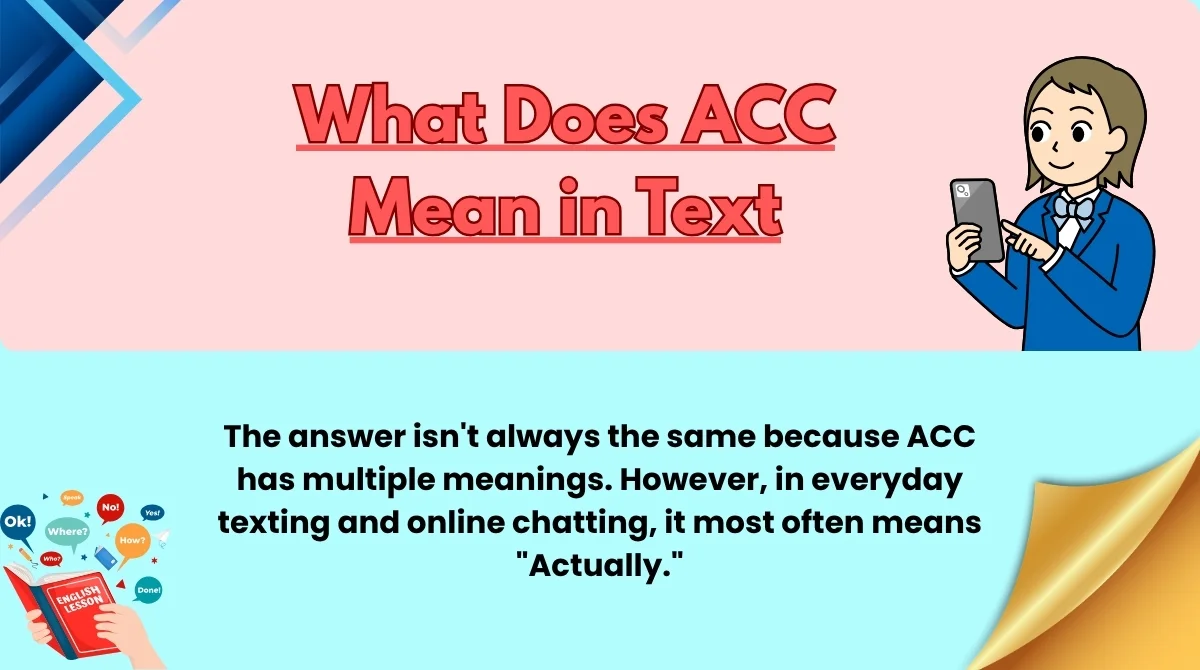
What Does ACC Mean in Text?
The answer isn’t always the same because ACC has multiple meanings. However, in everyday texting and online chatting, it most often means “Actually.”
People shorten “actually” to ACC because it’s quicker to type, especially during fast-paced conversations.
For example:
- “ACC, I changed my mind.”
- “I thought it was today, but ACC it’s tomorrow.”
- “ACC, you’re right about that.”
In these examples, ACC simply replaces the word “actually” without changing the meaning of the sentence.
Outside casual texting, ACC may also mean:
- Account (especially in gaming or social media)
- Accuracy (popular in gaming)
- Area Control Center (aviation)
- Adaptive Cruise Control (automotive)
That’s why context is everything when interpreting this abbreviation.
Origin and Background of the Term
Internet abbreviations have existed since the early days of online chat rooms in the 1990s. Back then, slow internet connections and limited keyboard speeds encouraged people to shorten common words.
As messaging apps like MSN Messenger, AOL Instant Messenger, and later WhatsApp, Snapchat, Instagram, and Discord became popular, abbreviations spread rapidly.
While abbreviations like “LOL” and “BRB” became globally recognized, shorter forms like ACC developed within smaller online communities. Younger users often created their own shortcuts to make conversations faster.
Today, the abbreviation continues evolving. Depending on where you spend time online, you may see ACC used differently, showing how internet language constantly changes with new trends.
How ACC Is Used in Daily Life
You’ll encounter ACC in many different situations.
1. Casual Text Messages
Friends often use it instead of “actually.”
Example:
“ACC, I don’t think I’ll be able to come tonight.”
2. Social Media Comments
Quick replies on TikTok, Instagram, Facebook, or X often include ACC to save time.
Example:
“ACC that’s hilarious!”
3. Online Gaming
Gamers frequently use ACC to mean accuracy.
Example:
“Your ACC improved after the update.”
4. Gaming Accounts
Players sometimes shorten account as ACC.
Example:
“I’m selling my old ACC.”
5. Workplace Conversations
Although less common, some teams use ACC as shorthand for account during internal chats.
Example:
“Can you update the client ACC?”
6. Educational Discussions
Students occasionally use ACC when referring to academic courses or institutions, depending on context.
Emotional or Practical Meaning of ACC
At first glance, ACC might seem like just another internet shortcut, but it reflects something much bigger—the way people communicate today.
Modern conversations value speed, convenience, and simplicity. Small abbreviations help people respond quickly without interrupting the flow of a conversation.
Imagine chatting with several friends at once. Instead of typing “actually” repeatedly, writing ACC saves time while keeping the conversation natural.
These small shortcuts also create a sense of belonging. People familiar with internet slang often understand each other instantly, strengthening online communities.
However, it’s also important to know your audience. Using abbreviations with someone unfamiliar with them may create confusion instead of making communication easier.
Similar or Related Terms
Here are some abbreviations that people often confuse with ACC:
- ACT – Usually refers to the ACT college entrance exam or simply “act.”
- Acct – Common abbreviation for account in business.
- A/C – Often means air conditioning.
- BTW – Means “By the way.”
- IMO – Means “In my opinion.”
- TBH – Means “To be honest.”
- IDK – Means “I don’t know.”
- FYI – Means “For your information.”
Although some of these abbreviations look similar, each has a completely different purpose.
Common Misunderstandings About ACC
Many people misunderstand this abbreviation. Here are some common misconceptions.
It Always Means Actually
Not true. While that’s common in texting, it can also mean account, accuracy, or several professional terms.
It Has Only One Meaning
Like many internet abbreviations, ACC changes meaning depending on the conversation.
Everyone Uses It
Some online communities use ACC frequently, while others rarely use it.
It’s Formal English
No. ACC belongs mainly to casual digital communication and isn’t suitable for formal writing.
Older People Never Use It
While younger users popularized it, people of all ages use internet abbreviations today.
It Appears in Every Dictionary
Many online abbreviations become popular before they’re officially recognized in dictionaries.
Examples of ACC in Sentences
Here are some natural examples you might see every day.
- ACC, I forgot about our meeting.
- I thought the movie started at seven, but ACC it starts at eight.
- Can you log into my gaming ACC while I’m away?
- Your shooting ACC has improved a lot.
- ACC, that’s one of my favorite songs.
- I wasn’t planning to travel, but ACC I found a cheap flight.
- His second ACC was banned yesterday.
- ACC, thanks for reminding me.
These examples show why context helps identify the intended meaning.
Why Understanding ACC Matters Today
Digital communication moves incredibly fast. New abbreviations appear almost every year, and understanding them makes conversations smoother and more enjoyable.
Knowing what does ACC mean in text can help you:
- Avoid misunderstandings.
- Communicate more confidently online.
- Follow conversations on social media.
- Understand gaming communities.
- Improve your digital communication skills.
As technology continues evolving, internet language will keep changing too. Staying familiar with common abbreviations helps you adapt and communicate effectively with people across different platforms.
Frequently Asked Questions
What does ACC mean in simple words?
In most text conversations, ACC simply means “actually.” Depending on the context, it may also stand for account or accuracy.
Is ACC positive or negative?
Neither. ACC is generally a neutral abbreviation. Its meaning depends entirely on how it’s used in the conversation.
Where is ACC commonly used?
You’ll most often see ACC in text messages, social media, online gaming, chat apps, forums, and messaging platforms. Its popularity may change over time as new internet slang emerges.
Is ACC formal or informal?
ACC is considered informal. It’s appropriate for casual conversations but should generally be avoided in professional emails, academic papers, and formal documents.
Why do people search for what does ACC mean in text?
People search for this phrase because internet slang changes constantly. As new abbreviations become popular over time, many users want to understand what they mean so they can communicate more confidently and avoid confusion.
Conclusion
Understanding what does ACC mean in text is easier once you know that its meaning depends on the situation. In casual messaging, it usually stands for “actually,” while in gaming, business, or other fields, it may represent account, accuracy, or another specialized term.
The next time you see ACC in a conversation, don’t rush to guess. Instead, look at the surrounding message to understand the intended meaning. That’s one of the simplest ways to become more confident in today’s fast-moving digital world.
Every new abbreviation you learn is another step toward becoming a smarter, more confident communicator in the ever-changing world of online conversations.

Happy is a passionate content creator and blogger who loves sharing creative ideas, meaningful words, and trending content with readers worldwide.With a simple writing style and fresh perspective, Happy aims to make every article engaging, helpful, and enjoyable to read.