When you hear the word “annexation,” your mind might jump to maps, borders, or headlines about countries claiming new territories.
But what does it really mean, and why does it matter today? Annexation isn’t just a political term—it carries historical weight, emotional significance, and practical implications in everyday conversations. Understanding it can give you deeper insight into history, current events, and even legal discussions.
Simply put, annexation refers to the act of adding or taking over territory, land, or property, usually by a government or authority.
While it may sound dry at first, its effects ripple through cultures, economies, and societies. Knowing what annexation means helps you make sense of international news, historical events, and even legal debates.
In this article, we’ll break down the meaning, origin, practical uses, and common misconceptions of annexation in a friendly, engaging way. By the end, you’ll not only understand the term but also see its relevance in modern life.
What Does Annexation Mean?
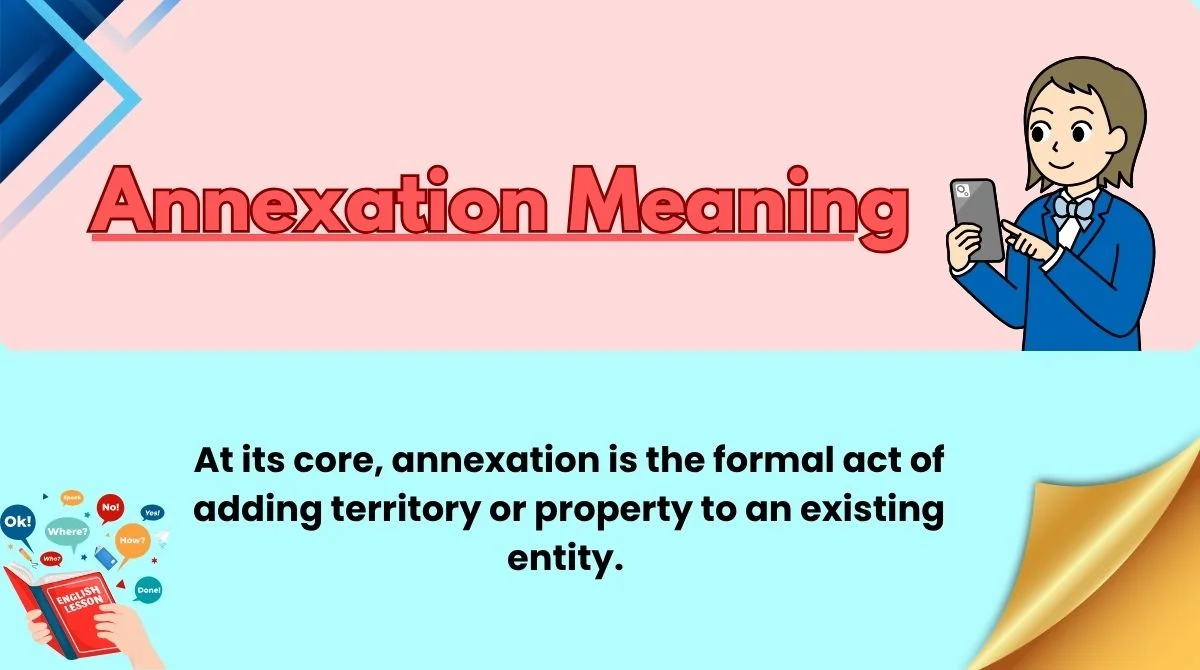
At its core, annexation is the formal act of adding territory or property to an existing entity. Think of it like combining two puzzle pieces to make a bigger picture—but in political or legal terms, it can be more complicated.
Real-life examples include:
- A city expanding its borders to include nearby towns.
- A country claiming a neighboring land after a war or treaty.
- A company acquiring smaller businesses to grow its operations.
So, annexation doesn’t always have to be about countries—it can happen on smaller scales too, like property or organizational contexts. The common thread is that something new is officially added to something bigger.
Origin and Background of the Term
The word “annexation” comes from the Latin word “annectere,” which means “to tie or bind to”. Historically, this idea of “binding” or “attaching” evolved into the legal and political sense we use today.
Historically, annexation has shaped the world map. For instance, in the 19th century, the United States annexed Texas, leading to political debates, cultural clashes, and eventually war with Mexico. Across Europe, annexations often sparked conflicts, shifting borders and influencing generations.
By understanding its roots, you see that annexation isn’t just an abstract word—it carries stories of power, negotiation, and identity.
How Annexation Is Used in Daily Life
Annexation may sound like a political term, but you’ll see it in daily life more than you think:
- Local Government: Cities may annex nearby unincorporated areas for better infrastructure or tax purposes.
- Business: Companies “annex” smaller startups through mergers and acquisitions.
- Property: Homeowners might annex a backyard or additional land to expand their property.
- Education: School districts sometimes annex smaller districts to optimize resources.
- History Lessons: Teachers explain past annexations to help students understand wars, treaties, and colonization.
In each case, the essence is the same: something new becomes officially part of an existing whole.
Emotional or Practical Meaning of Annexation
Annexation isn’t just bureaucratic—it often carries emotional weight. For communities, being annexed can mean a loss of identity or autonomy. For leaders, it can signify growth, power, or achievement.
Culturally, annexation has shaped languages, traditions, and social structures. For instance, when a region is annexed by another country, local customs may blend with the new authority’s laws or practices. Understanding annexation helps us empathize with people affected by political decisions, making history and current events feel more human.
Similar or Related Terms
Here are some terms closely related to annexation:
- Acquisition: Often used in business; similar but less political.
- Incorporation: Typically about including a smaller entity into a larger one, often legally.
- Annex: A verb meaning to add something; can be property, territory, or a document.
- Occupation: Temporarily controlling a territory, usually during conflict.
- Merger: Combining two entities into one, usually business-related.
Each term overlaps with annexation but differs in intent, permanence, and context.
Common Misunderstandings About Annexation
- It’s only about countries: Annexation can happen with property, cities, or businesses too.
- It’s always hostile: Sometimes annexation is peaceful, like a voluntary merger or agreement.
- It’s illegal by default: Many annexations follow legal procedures and treaties.
- Annexation equals occupation: Occupation can be temporary; annexation is official and permanent.
- People always accept it: Annexed populations may resist or protest, leading to conflicts.
- It’s a modern concept: Annexation has existed for centuries, even in ancient empires.
Examples of Annexation in Sentences
- The city council voted to annex the neighboring village to improve public services.
- In 1845, the U.S. officially annexed Texas, creating a new state.
- The company plans to annex smaller startups to expand its market.
- Historical maps show how empires annexed territories over centuries.
- Residents were concerned about taxes after their town was annexed by the city.
- The country refused to recognize the neighboring nation’s annexation of disputed land.
- School districts can annex smaller areas to streamline resources.
- The museum decided to annex the old library into its new exhibit space.
Why Understanding Annexation Matters Today
Annexation is more than history—it impacts modern politics, economics, and social identity. From global disputes to city planning, knowing what annexation means helps you understand how territories grow, change, and affect lives.
It also encourages critical thinking: when you see a government claim new land, you can ask, “Is this fair? Legal? Ethical?” Understanding annexation equips you with context for news, debates, and international relations.
Frequently Asked Questions
What does annexation mean in simple words?
Annexation means officially adding or taking over land, property, or territory, often by a government or authority.
Is annexation positive or negative?
It depends. It can lead to growth and opportunity, but sometimes causes conflict or loss of autonomy.
Where is annexation commonly used?
In politics, city planning, business mergers, property management, and historical discussions.
Is annexation formal or informal?
It’s typically a formal act, often following legal or governmental procedures.
Why do people search for annexation?
To understand history, news, property law, or political events.
Conclusion
Annexation may sound like a heavy political term, but it’s deeply woven into our history, culture, and daily life.
From cities expanding their borders to countries redrawing maps, it shapes the way we live and relate to each other.
By understanding annexation, we not only grasp the mechanics of power and growth but also learn empathy for those affected. Every addition has a story, and every annexation changes lives.

Happy is a passionate content creator and blogger who loves sharing creative ideas, meaningful words, and trending content with readers worldwide.With a simple writing style and fresh perspective, Happy aims to make every article engaging, helpful, and enjoyable to read.