Have you ever stumbled upon the term “marquess” while reading historical novels, watching period dramas, or browsing British peerage lists, and wondered what it actually means?
You’re not alone. This elegant-sounding title can feel mysterious, but understanding it opens a window into history, culture, and even modern social structures.
A marquess is more than just a fancy title—it carries centuries of tradition, social significance, and hierarchy.
While it may sound intimidating, its meaning is simple once broken down. In today’s world, knowing terms like these helps you decode literature, understand historical contexts, and even impress your friends at trivia nights!
Let’s dive into the fascinating world of the marquess meaning and explore its history, usage, and relevance today.
What Does Marquess Mean?
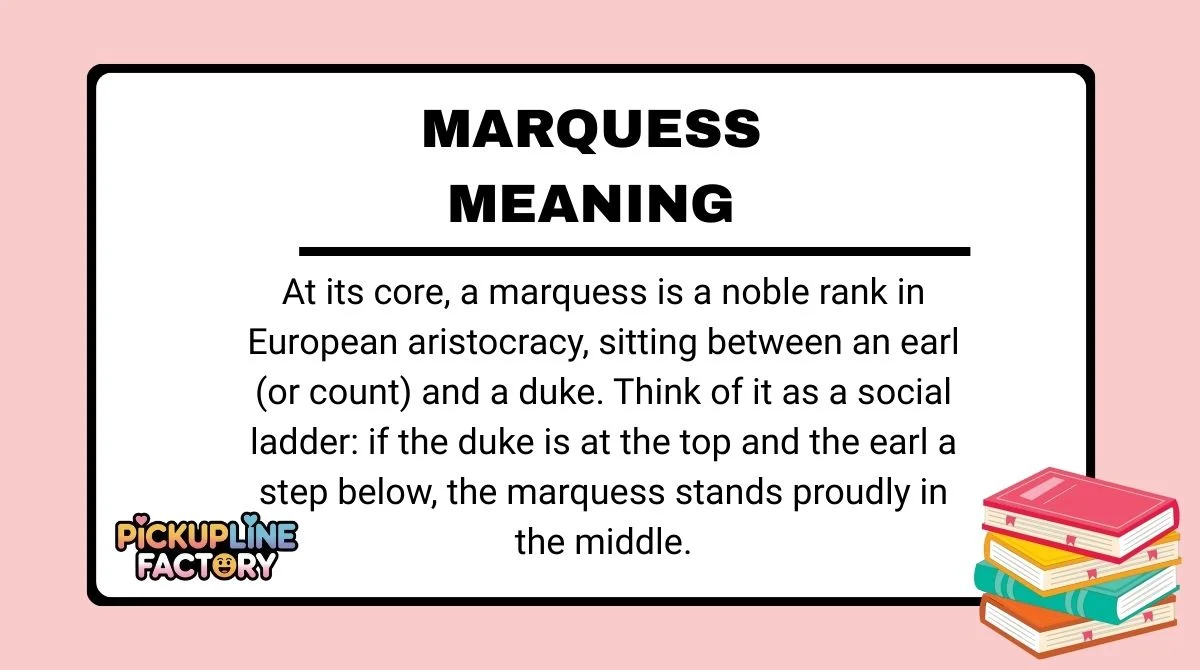
At its core, a marquess is a noble rank in European aristocracy, sitting between an earl (or count) and a duke. Think of it as a social ladder: if the duke is at the top and the earl a step below, the marquess stands proudly in the middle.
In simpler terms, a marquess is someone who rules or governs a border territory, historically tasked with protecting regions on the edges of a kingdom. It’s a mix of authority, responsibility, and prestige.
Real-life examples:
- In the UK, the Marquess of Bath is a well-known title tied to Longleat House.
- Fictional characters like those in historical dramas or Jane Austen novels sometimes hold the title of marquess, adding a touch of prestige and influence to their storylines.
- In modern media, the term is often used metaphorically to describe someone with authority or elite status in society.
Origin and Background of the Term
The word “marquess” comes from the Old French term marquis, which itself derives from the Medieval Latin marchio, meaning “ruler of a border area”. Back in the Middle Ages, kingdoms were concerned about invasions. To protect vulnerable borders, rulers appointed trusted nobles—marquesses—to defend and manage these lands.
Imagine a time when borders weren’t marked by fences but by forests, rivers, or enemy forces. Being a marquess meant bravery, strategy, and loyalty. Unlike dukes, who governed entire provinces, marquesses were like the kingdom’s first line of defense, making their role critical yet distinct.
Over time, as warfare evolved and borders stabilized, the title became more ceremonial, symbolizing prestige rather than military responsibility, but the historical weight of the role remains in its cultural memory.
Marquess Meaning in English
In English, the word “marquess” refers to a noble title ranking above an earl and below a duke in the British peerage system. Historically, a marquess was a powerful lord responsible for guarding border territories known as marches. The title comes from the Old French word marquis, which itself originated from words related to frontier or boundary lands. Today, the term is mostly associated with royalty, aristocracy, and historical traditions in countries such as the United Kingdom. A person holding this title is addressed formally and is often connected with inherited honor, land, and social prestige. For example, “The Marquess of Bath” is a well-known British noble title. In literature and movies, marquesses are often portrayed as wealthy, influential, and sophisticated individuals. Understanding the English meaning of marquess helps readers better understand history, royal rankings, and classic English vocabulary that still appears in books, news articles, and cultural discussions today.
How Marquess Is Used in Daily Life
Today, most people don’t interact with a marquess in person, but the term still pops up in literature, media, and formal contexts. Here’s how:
- Historical novels & dramas – Authors use “marquess” to signal status, wealth, and social hierarchy.
- Genealogical records – Family historians often encounter marquess titles in lineage charts.
- Cultural references – TV shows like Downton Abbey or movies set in aristocratic Europe mention marquesses to enhance authenticity.
- Metaphorical usage – Sometimes, people refer to someone as a “marquess” to describe a high-ranking or influential position in a humorous or exaggerated way.
- Collectibles & tourism – Estates like Longleat or Chatsworth House attract visitors curious about the marquessial lifestyle.
In short, while you may never meet a marquess, knowing the term enriches your cultural literacy.
Emotional or Practical Meaning of Marquess
Why does this matter today? Beyond history books, the title carries a sense of prestige, responsibility, and influence. Understanding it helps us:
- Appreciate historical storytelling and character motivations in literature or media.
- Decode references in political or cultural discussions, especially in countries with aristocratic traditions.
- See the evolution of leadership roles, from protecting borders to ceremonial representation.
On a deeper level, learning about marquesses reminds us that every title carries a story, a purpose, and a legacy—just like our own roles in society, big or small.
Similar or Related Terms
- Duke – Higher rank than marquess, often overseeing larger regions.
- Earl / Count – Lower than marquess, responsible for smaller territories.
- Viscount – Ranked below earl, above baron.
- Baron – The entry-level title in most European peerage systems.
- Marchioness – Female equivalent of a marquess.
Each term signals a specific rank, authority, and historical responsibility, so mixing them up can change the meaning significantly.
Common Misunderstandings About Marquess
- It’s the same as a duke – Wrong. Dukes outrank marquesses.
- It’s purely ceremonial today – Partially true; historically, it was a military role.
- Marquesses are everywhere in Europe – Mostly Western Europe; some countries use different terms.
- A marquess rules a modern country – No, it’s mostly symbolic now.
- It’s an easy title to inherit – Usually follows strict hereditary rules.
- Women can’t be marquess – Women can hold the title as marchioness or inherit in special cases.
Examples of Marquess in Sentences
- The Marquess of Winchester attended the royal ceremony in full regalia.
- In her novel, the protagonist falls in love with a charming marquess.
- During the tour, the guide explained how the marquess historically defended the borderlands.
- He joked that his new office cubicle made him feel like a marquess in a tiny kingdom.
- The marquessial estate was renowned for its gardens and lavish architecture.
- Historical records mention that the marquess played a key role in local politics.
- Becoming a marquess today carries prestige more than power.
- She dressed like a marchioness for the costume ball, capturing the essence of nobility.
Why Understanding Marquess Matters Today
Even if we no longer live in feudal Europe, knowing about marquesses gives us:
- Cultural literacy – Understand historical references in books, shows, and films.
- Social awareness – Recognize how society structured itself historically.
- Storytelling insight – Writers and readers benefit from understanding rank and etiquette.
Essentially, exploring titles like marquess lets us connect the past with modern culture in fun and meaningful ways.
Marquess Meaning Slang
In slang or casual conversation, the word “marquess” is not commonly used the same way as modern internet slang, but people sometimes use it humorously or metaphorically to describe someone who acts classy, wealthy, powerful, or overly aristocratic. Since a marquess is a noble rank in British nobility, the term can carry a stylish or high-status vibe when used jokingly among friends or online communities. For example, someone might call a fashion-forward friend “the marquess of style” to tease them about acting elegant or royal. In gaming, memes, or social media, old royal titles like marquess are occasionally used to create dramatic or funny personalities. While it is mainly a formal historical title, slang usage gives it a playful twist connected with luxury, sophistication, and authority. Understanding the slang side of “marquess” helps people recognize how traditional words can evolve into modern expressions in pop culture and online conversations while still keeping their original noble feeling alive in a fun way.
Marquess Meaning in Royalty
In royalty, a marquess is a noble title that ranks below a duke and above an earl in the British peerage system. Historically, a marquess was appointed to govern and protect important border regions, known as marches, which were often vulnerable to invasion. Because these territories were strategically significant, a marquess held considerable authority and was trusted by the monarch to maintain security and order. Although the military responsibilities associated with the title have largely disappeared, the rank remains an important part of the British aristocracy and ceremonial tradition. Today, a marquess may inherit the title through family lineage and is often associated with historic estates, noble heritage, and centuries-old traditions rather than political power. Understanding the marquess meaning in royalty helps explain the structure of noble ranks and the role each title played in supporting the monarchy. While modern marquesses rarely exercise official governing authority, the title continues to symbolize prestige, honor, and a lasting connection to the history of the royal family and the evolution of the British peerage system.
Frequently Asked Questions
What does marquess mean in simple words?
A marquess is a noble title between an earl and a duke, historically responsible for protecting border areas.
Is marquess positive or negative?
It’s positive, signifying prestige, authority, and respect.
Where is marquess commonly used?
Primarily in the UK, France, and other Western European countries, mostly in historical or ceremonial contexts.
Is marquess formal or informal?
It’s formal, used in aristocracy, literature, and official records.
Why do people search for marquess?
People are curious about history, literature, genealogy, and culture, as well as fictional representations in novels and films.
Conclusion
Understanding the marquess meaning isn’t just about memorizing a dictionary definition. It’s about unlocking history, culture, and stories that have shaped societies for centuries.
Whether you’re reading a classic novel, exploring family lineage, or enjoying a period drama, knowing what a marquess is adds depth and context.
Remember, every title tells a story—and every story teaches us something about responsibility, prestige, and human history. Embrace it, and let the world of marquesses inspire your curiosity and imagination!

Happy is a passionate content creator and blogger who loves sharing creative ideas, meaningful words, and trending content with readers worldwide.With a simple writing style and fresh perspective, Happy aims to make every article engaging, helpful, and enjoyable to read.