Have you ever flipped through a book, scrolled online, or looked at an article and noticed those little pictures that instantly grab your attention?
Those are illustrations, and they do more than just make content pretty—they tell stories, explain ideas, and bring concepts to life. But what does “illustration” actually mean, and why is it important in our daily lives?
At its core, an illustration is any visual representation created to explain, decorate, or enhance written text or ideas.
Unlike plain photographs, illustrations are often designed to clarify concepts, evoke emotions, or add a personal touch to information.
Whether it’s a children’s storybook, a technical manual, or a social media post, illustrations help people understand and connect with content faster.
Understanding the meaning of illustration is more than a technical exercise. It helps writers, designers, marketers, and even casual creators communicate ideas effectively and creatively.
In this article, we’ll explore its origins, uses, emotional significance, and common misconceptions—all in a friendly, human style that’s easy to follow.
What Does Illustration Mean?
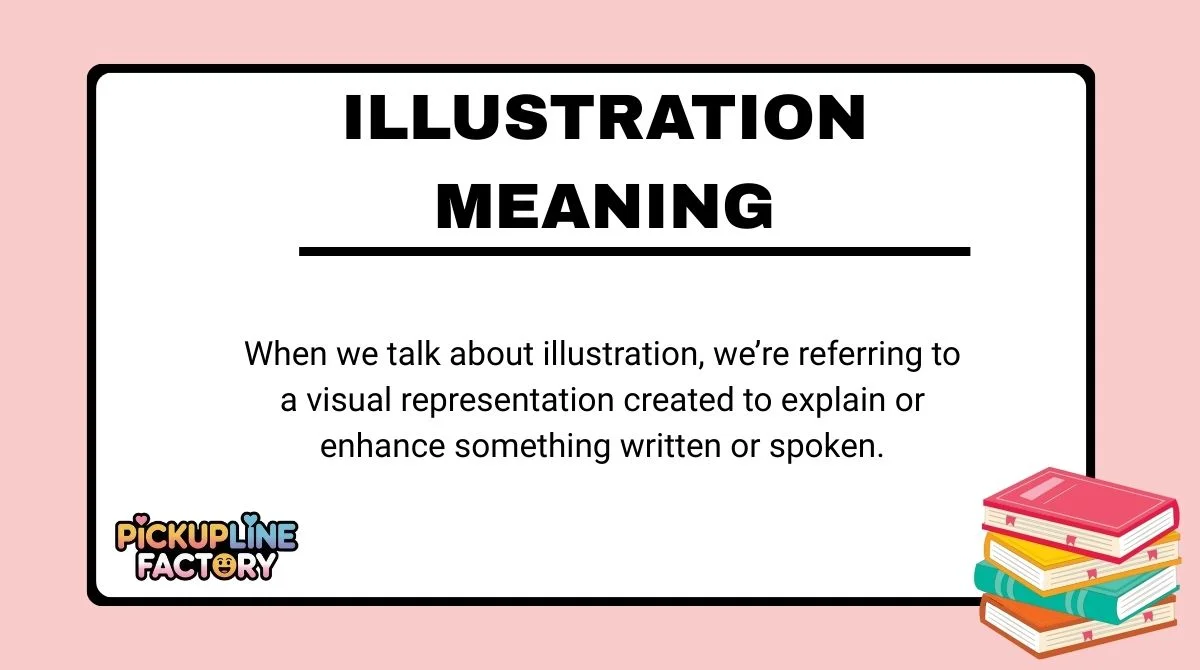
When we talk about illustration, we’re referring to a visual representation created to explain or enhance something written or spoken. It’s not just a random drawing; it’s a tool that adds clarity or beauty to communication.
Examples in real life include:
- Children’s books: Colorful drawings that bring stories to life.
- Infographics: Charts and visuals that simplify complex data.
- Editorial illustrations: Images in magazines or newspapers that make articles more engaging.
Think of it this way: illustrations are like a bridge connecting words to understanding. They make abstract ideas concrete and help people remember concepts better.
Origin and Background of the Term
The word “illustration” comes from the Latin word illustratio, which means “enlightenment” or “illumination.” Literally, it was about shedding light on something unclear.
Historically, illustrations have existed for thousands of years. Cave paintings in Lascaux, France, for example, served as visual storytelling for ancient humans, conveying hunting techniques and daily life before written language existed.
During the Renaissance, illustrations became more sophisticated with books and manuscripts. Artists like Leonardo da Vinci created illustrations to explain scientific concepts. Fast forward to today, and illustrations are everywhere—from digital media to advertising.
The journey of illustrations shows that humans have always relied on visual storytelling to enhance communication.
Illustration Meaning Example
To fully understand the meaning of illustration, it’s helpful to see how the word is used in real-life examples. An illustration can refer to both a picture and an explanation, depending on the context. For instance, in books or magazines, an illustration often means a drawing or image that supports the written content. A sentence like, “The children enjoyed the colorful illustrations in the storybook,” clearly shows its visual meaning.
On the other hand, illustration can also mean an example used to clarify a point. For example, “The teacher gave an illustration to explain the concept,” shows how the word is used in an educational sense. These examples make it easier to understand how flexible the term is. By seeing illustration used in different sentences, you can quickly learn when it refers to a visual image and when it means a helpful explanation. This makes your understanding stronger and your usage more natural.
How Illustration Is Used in Daily Life
Illustrations aren’t just for artists—they appear all around us:
- Education: Diagrams in textbooks simplify complex ideas like the human circulatory system.
- Marketing: Eye-catching visuals on social media or advertisements grab attention.
- Instruction manuals: Step-by-step illustrations make assembly or usage easy.
- Children’s literature: Illustrations spark imagination and help kids understand stories.
- Presentations: Charts, graphs, and sketches make information memorable.
- Digital content: Emojis, gifs, and custom drawings illustrate emotions or actions.
In short, illustrations make everyday communication more visual, engaging, and easier to understand.
Emotional or Practical Meaning of Illustration
Illustrations are powerful because they blend information with emotion. A single image can evoke joy, sadness, curiosity, or inspiration.
For example, a drawing of a child holding a globe can inspire environmental awareness, while a comic strip can bring humor to a serious topic. They also bridge cultural gaps, as visuals are often universally understood even without words.
Practically, illustrations help people retain information faster. Studies show that people remember illustrated concepts better than text-only content. So whether for learning, marketing, or storytelling, illustrations are both emotionally and cognitively impactful.
Similar or Related Terms
Here are some terms related to illustration:
- Graphic design: Focuses on creating visual content for communication. Illustrations are a subset.
- Artwork: Broader term; includes any creative visual expression.
- Infographics: Combines illustrations with data for easy understanding.
- Cartoon: Often humorous or exaggerated illustrations.
- Sketch: Rough preliminary drawing, can be a type of illustration.
Each term overlaps but differs in purpose, style, and usage.
Common Misunderstandings About Illustration
- “Illustration is just drawing.”
False—illustrations convey meaning, not just decoration. - “Photos count as illustrations.”
Not exactly. Photos capture reality; illustrations often interpret or enhance it. - “Only artists can create illustrations.”
Wrong. Anyone can create illustrations, especially with digital tools. - “Illustrations are only for kids.”
Incorrect. They’re widely used in technical, marketing, and professional contexts. - “Illustrations replace text.”
They complement, clarify, or enhance text, not replace it. - “All illustrations are digital nowadays.”
Many are hand-drawn, painted, or printed.
Examples of Illustration in Sentences
- The textbook included illustrations of the solar system to help students visualize planets.
- Her blog post featured a cute illustration of a cat drinking coffee, making it more relatable.
- The magazine article had an editorial illustration showing the economic impact visually.
- We added infographics and illustrations to our presentation for clarity.
- The children’s storybook was full of vibrant illustrations that sparked imagination.
- He created a detailed illustration of the new product for the design team.
- The comic strip uses humorous illustrations to convey a serious message.
- The recipe book included illustrations showing each cooking step.
Why Understanding Illustration Matters Today
In a digital world overflowing with information, illustrations help ideas stand out. They make content more memorable, shareable, and engaging.
For educators, they improve learning outcomes. For marketers, they grab attention and drive engagement. Even for casual social media users, illustrations express creativity and emotion.
Understanding illustrations also allows people to appreciate and use them intentionally, whether for storytelling, communication, or business.
Illustration Meaning Synonyms
The word illustration carries several meanings depending on the context, which is why its synonyms can vary widely. In general, an illustration refers to a visual representation—such as a drawing, picture, or diagram—used to explain or decorate text. In this sense, common synonyms include image, drawing, sketch, diagram, and visual. However, illustration can also mean an example used to clarify an idea or concept. In that case, synonyms like example, instance, case, and demonstration are more appropriate.
Understanding these synonyms helps you choose the right word depending on how you’re using illustration. For example, in design or art, you might say graphic or artwork, while in writing or teaching, example or explanation fits better. Using the correct synonym not only improves clarity but also enhances your writing style. Whether you’re creating content, studying English, or improving communication skills, knowing these alternatives allows you to express ideas more precisely and effectively.
Illustration Meaning Synonyms
The word illustration has several synonyms, and the best one depends on the context in which it is used. When referring to a drawing or picture, common synonyms include image, drawing, sketch, artwork, diagram, graphic, visual, and figure. In writing or education, illustration can also mean an example or explanation that helps make an idea easier to understand. In that context, words like example, demonstration, clarification, representation, interpretation, and depiction are often suitable alternatives. Although these words are related, they are not always interchangeable. For instance, a diagram is usually used to explain how something works, while a sketch refers to a simple hand-drawn image. An example illustrates a concept through words rather than visuals. Choosing the right synonym depends on whether you are talking about art, education, communication, or design. Understanding these related words helps improve vocabulary, enhances writing, and allows you to express ideas more accurately in different situations.
Frequently Asked Questions
What does illustration mean in simple words?
It’s a visual representation designed to explain, decorate, or enhance written or spoken content.
Is illustration positive or negative?
Illustrations are generally neutral, but their tone depends on context—they can be funny, serious, or emotional.
Where is illustration commonly used?
Books, magazines, websites, social media, advertisements, presentations, and educational materials.
Is illustration formal or informal?
It can be both. Illustrations appear in professional documents as well as casual content.
Why do people search for illustration meaning?
To understand its purpose, create better visuals, or improve communication in creative, educational, or marketing contexts.
Conclusion
Illustrations are more than just pretty pictures—they’re powerful communication tools. From explaining complex ideas to evoking emotion, they make content understandable, engaging, and memorable.
Next time you see an illustration, take a moment to appreciate the story, meaning, and creativity behind it.
Remember, a single image can sometimes say more than a thousand words, and in a world full of information, that’s priceless.

Happy is a passionate content creator and blogger who loves sharing creative ideas, meaningful words, and trending content with readers worldwide.With a simple writing style and fresh perspective, Happy aims to make every article engaging, helpful, and enjoyable to read.