Have you ever listened to someone speak and felt their words dance with emotion? That’s prosody at work.
Whether it’s the rise and fall of a storyteller’s voice, the beat in your favorite song, or the cadence of a heartfelt conversation, prosody is everywhere.
Simply put, prosody is the melody and rhythm of speech that conveys meaning beyond the words themselves.
Understanding prosody isn’t just for linguists or actors—it can enhance communication, help us read emotions better, and even improve our writing.
By grasping the essence of prosody, we unlock a new dimension of how humans connect through language.
In this article, we’ll explore what prosody really means, its origins, practical uses, and why it’s more relevant today than ever.
What Does Prosody Mean?
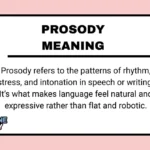
Prosody refers to the patterns of rhythm, stress, and intonation in speech or writing. It’s what makes language feel natural and expressive rather than flat and robotic.
Think about when someone says, “I can’t believe you did that!” The meaning changes completely depending on how they say it—excited, angry, surprised, or sarcastic. That shift in tone, pitch, and pacing is prosody in action.
Examples in real life:
- A teacher emphasizing key points with a rising intonation to keep students engaged.
- A friend telling a joke, where timing and pauses make it funny.
- A singer delivering lyrics with emotional ups and downs.
Prosody is essentially the music of language—it shapes how words are perceived emotionally and intellectually.
Origin and Background of the Term
The word “prosody” comes from the Greek word “prosōidía”, meaning “song sung to a note.” Originally, it referred to the patterns of meter and rhythm in poetry, but over time, its meaning expanded to include speech and linguistic expression.
In ancient times, prosody was studied as part of rhetoric and poetry. Greek scholars analyzed how intonation, stress, and syllable length affected the beauty and clarity of language. By the Renaissance, poets and playwrights like Shakespeare were using prosody to create emotional resonance in their works.
So, prosody has a long history, connecting language, music, and human emotion across centuries. It’s fascinating to see how something so subtle shapes communication in profound ways.
How Prosody Is Used in Daily Life
Prosody isn’t just for scholars—it’s something we all use every day, often unconsciously. Here are a few ways it appears in daily life:
- Conversations – Changing your pitch or pace to express excitement or disappointment.
- Storytelling – Using pauses and emphasis to make tales captivating.
- Public Speaking – Speakers vary their tone to keep audiences engaged.
- Phone Calls – Tone of voice conveys friendliness, urgency, or sarcasm.
- Teaching and Learning – Emphasizing important words helps retention.
- Music and Poetry – Songs and poems rely on rhythm, stress, and intonation.
Prosody is subtle but powerful, shaping how others perceive your words and emotions.
Emotional or Practical Meaning of Prosody
Prosody isn’t just about sounding nice—it has real emotional and social significance.
- Emotion recognition: We often infer feelings from tone rather than words. “I’m fine” can mean very different things depending on pitch or stress.
- Social bonding: Matching the rhythm and intonation of someone else’s speech fosters connection and empathy.
- Cultural expression: Different languages and cultures have unique prosodic patterns, reflecting social norms and values.
In modern contexts, like virtual meetings or audiobooks, prosody enhances clarity and engagement, making communication more effective and human.
Similar or Related Terms
- Intonation: The rise and fall of pitch in speech. Prosody includes this.
- Rhythm: The timing and flow of speech or poetry.
- Stress: Emphasis placed on syllables or words.
- Cadence: The natural rhythmic flow of language.
- Tone: Emotional coloring of speech.
Each term overlaps with prosody but highlights a specific aspect of how language moves and feels.
Common Misunderstandings About Prosody
- Prosody is only for poetry.
Reality: It’s in everyday speech, not just literature. - It’s the same as tone.
Reality: Tone is part of prosody, but prosody also includes rhythm and stress. - Children don’t use prosody.
Reality: Babies recognize intonation and rhythm before they speak full words. - Prosody doesn’t matter in text.
Reality: Writers use punctuation, sentence length, and formatting to convey rhythm and emphasis. - It’s complicated to master.
Reality: Most people naturally adjust prosody in conversation; awareness just enhances it.
Examples of Prosody in Sentences
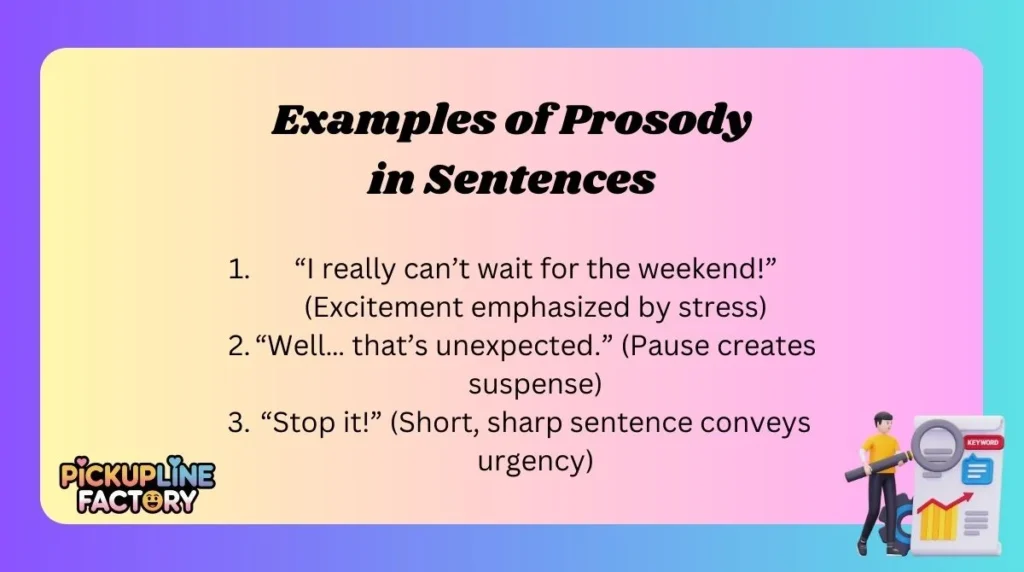
- “I really can’t wait for the weekend!” (Excitement emphasized by stress)
- “Well… that’s unexpected.” (Pause creates suspense)
- “Stop it!” (Short, sharp sentence conveys urgency)
- “I suppose that could work.” (Rising intonation implies uncertainty)
- “Congratulations!” (Pitch and duration convey enthusiasm)
- “I… don’t know what to say.” (Pauses express hesitation)
- “You’re amazing.” (Slow pace adds sincerity)
- “Hurry up!” (Fast rhythm signals urgency)
Why Understanding Prosody Matters Today
In today’s digital age, communication is often text-based, yet prosody still matters:
- Voice assistants like Alexa or Siri use prosody to sound more human.
- Remote work and calls rely on tone to convey meaning without visual cues.
- Language learning emphasizes prosody to achieve natural-sounding speech.
- Public speaking and content creation depend on rhythm and emotion to engage audiences.
In short, prosody bridges the gap between words and human connection, making interactions richer and more meaningful.
Frequently Asked Questions
What does prosody mean in simple words?
Prosody is the rhythm, pitch, and stress of speech that adds emotion and meaning to words.
Is prosody positive or negative?
Prosody itself is neutral—it conveys emotions which can be positive, negative, or neutral.
Where is prosody commonly used?
Everywhere: conversations, storytelling, poetry, music, teaching, and even technology like AI voices.
Is prosody formal or informal?
It’s both. Prosody appears in casual chats and formal speeches, adapting to context.
Why do people search for prosody?
People want to improve communication, understand emotions in speech, or enhance their writing and public speaking skills.
Conclusion
Prosody is more than a linguistic term—it’s the heartbeat of human communication. By understanding rhythm, stress, and intonation, we can connect more deeply, express emotions clearly, and make our words truly resonate.
Next time you speak or write, pay attention to prosody—it might just transform the way people hear and feel your words.
Remember, it’s not just what you say—it’s how you say it that matters.