In today’s digital world, short forms and abbreviations are widely used in texting, social media, and online communication.
One of the most common abbreviations you will often see is “PM”. Many people search for “what does PM mean in text” because its meaning can change depending on the situation and platform being used.
For beginners, this can be confusing since PM is used in different contexts like chatting, scheduling time, and even professional communication.
In texting, PM usually means “Private Message,” which refers to sending a direct and private chat to someone instead of posting publicly.
However, in time format, PM stands for “Post Meridiem,” which indicates the afternoon and evening hours (after 12 noon).
Because of these two major meanings, users often misunderstand it. This article explains PM in detail, its different uses, and how you can correctly understand it in conversations.
Meaning & Definition
The abbreviation PM has multiple meanings, but the most common ones are “Private Message” and “Post Meridiem.”
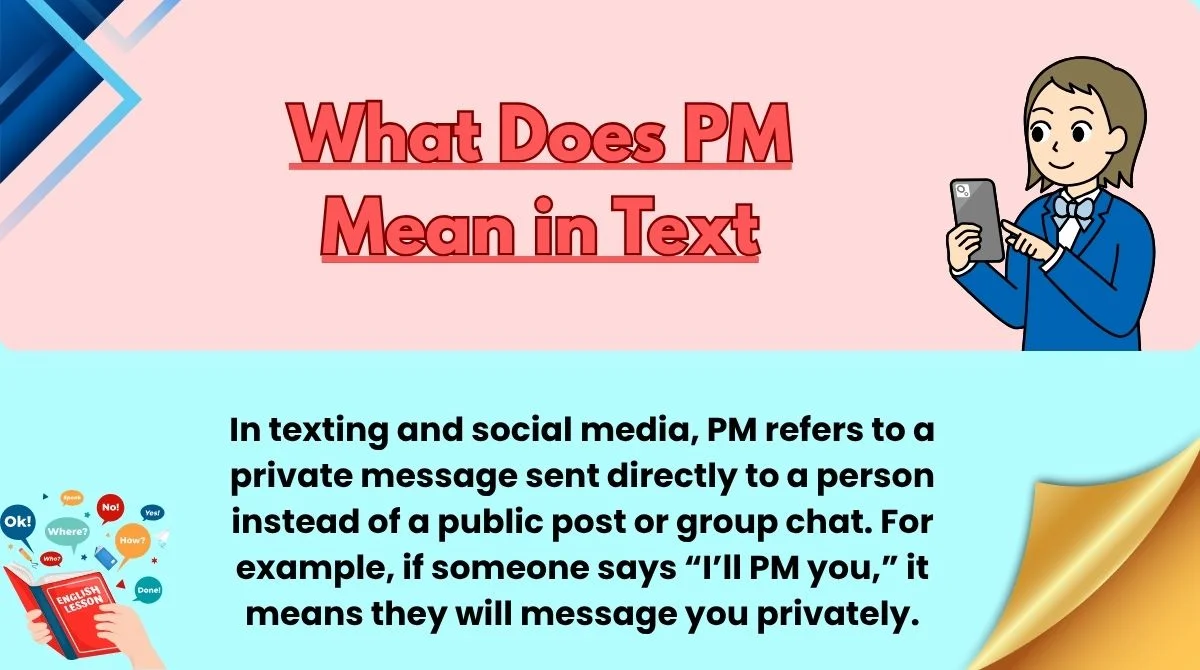
In texting and social media, PM refers to a private message sent directly to a person instead of a public post or group chat. For example, if someone says “I’ll PM you,” it means they will message you privately.
In time-related usage, PM stands for “Post Meridiem,” a Latin term meaning “after midday.” It is used in the 12-hour clock system to represent time from 12:00 noon to 11:59 at night. For example, 3:00 PM means 3 o’clock in the afternoon.
Understanding the correct meaning depends on the context of the conversation. In digital communication, “private message” is more commonly used, while in clocks and schedules, “post meridiem” is standard. This dual meaning is the reason many people get confused when they see PM in messages or posts.
Background
The origin of PM as “Post Meridiem” comes from the Latin language, which was widely used in ancient Roman timekeeping systems. The 12-hour clock system was developed to divide the day into two parts: AM (before midday) and PM (after midday). This system became globally popular and is still used in countries like the United States, Pakistan, and many others.
On the other hand, the digital meaning of PM as “Private Message” emerged with the rise of online communication platforms. Early internet forums, chat rooms, and social networks introduced PM features to allow users to communicate privately without sharing messages publicly. Over time, this abbreviation became widely used on platforms like Facebook, Instagram, and messaging apps.
Today, PM exists in both traditional timekeeping and modern digital communication, making it a versatile and widely recognized abbreviation.
Usage in Different Contexts (Chat, Social Media, Professional Fields)
In chat and social media, PM is commonly used when someone wants to continue a conversation privately. For example, “PM me your details” means send your information in a private message instead of public chat.
On platforms like Facebook, Instagram, and Twitter (X), PM often refers to direct messages (DMs), though both terms are sometimes used interchangeably.
In professional fields, PM is usually understood in two ways: “Private Message” in workplace communication tools like Slack or Teams, and “Post Meridiem” in scheduling meetings or appointments.
For example, a meeting scheduled at 2:00 PM clearly uses the time-based meaning. Meanwhile, a manager saying “I’ll PM you the file” refers to sending a private message. Understanding the context is essential because the abbreviation changes meaning based on usage.
Meaning in Chat, WhatsApp, Instagram, TikTok
In chat apps like WhatsApp, PM is less commonly used because chats are already private. However, users still say “PM me” when referring to messaging someone personally.
On Instagram, PM is often used instead of “DM,” especially in casual conversations. For example, “PM me the price” means send a direct message.
On TikTok, creators sometimes use PM in comments or captions to ask viewers to message them privately for collaboration or details.
Overall, in modern social media culture, PM and DM are often interchangeable, but DM is more widely used. Still, PM remains popular in informal texting and older internet communities.
Meaning in Physics, Medical, and Aircraft Terminology
In physics, PM can sometimes refer to “picometer,” a unit of length equal to one trillionth of a meter (10⁻¹² meters). It is used in scientific measurements at atomic levels.
In medical contexts, PM may refer to “post-mortem,” which is an examination of a body after death to determine the cause. However, this is usually written as PM in notes or shorthand.
In aviation, PM stands for “Pilot Monitoring,” which is a role in a cockpit where one pilot assists and monitors the other pilot flying the aircraft.
These meanings are specialized and not related to texting, but they show how the abbreviation PM is used across different fields.
Common Misconceptions
One common misconception is that PM always means “private message.” In reality, it depends on context. Many beginners assume every PM in chat means messaging privately, but sometimes it refers to time.
Another confusion is mixing PM with DM. While both mean direct communication, DM is the standard term on most modern platforms, while PM is more traditional or informal.
Some people also mistakenly think PM has a single universal meaning, which is incorrect. It is a context-based abbreviation with multiple interpretations.
Similar Terms & Alternatives
Some similar terms to PM include:
- DM (Direct Message) – commonly used on social media
- Inbox message – used in email or business platforms
- Private chat – general term for one-on-one messaging
- AM – opposite of PM in time formatting
These alternatives help users understand communication or time in different systems. Among them, DM is the closest digital alternative to PM in texting.
How to Respond to It
If someone says “PM me,” your response should be simple and direct. You can reply with:
- “Sure, I’ll message you privately.”
- “Okay, check your inbox.”
- “Sending you a PM now.”
If PM refers to time, no response is needed because it is just a time format. For example, “3:00 PM” is informational, not conversational.
Understanding the context ensures you respond correctly and avoid confusion in conversations.
Differences from Similar Words
PM differs from DM mainly in usage. DM is widely used on modern platforms like Instagram and Twitter, while PM is more traditional and still common in forums or older chat systems.
PM (Post Meridiem) is also different from AM (Ante Meridiem), which refers to morning hours before noon.
In communication, PM is more general, while DM is more platform-specific. This distinction helps users choose the correct term depending on where they are chatting.
Relevance in Online Conversations & Dating Apps
In online conversations and dating apps, PM is often used when someone wants to move from public interaction to private messaging. For example, a user might say, “PM me if you’re interested,” which means continue the conversation privately.
It helps maintain privacy and creates a more personal interaction. However, on modern dating apps, in-app messaging systems already serve this purpose, so the term PM is less common but still understood.
Overall, PM remains relevant in digital communication because it provides a simple way to request private conversation.
Conclusion
The abbreviation PM is widely used in both digital communication and time formatting, making it an important term to understand.
In texting, it usually means “Private Message,” while in clocks it stands for “Post Meridiem,” indicating afternoon and evening hours. Its meaning changes depending on context, which is why many people search for its definition.
From social media chats to professional settings, PM continues to play a role in how people communicate and schedule time.
Understanding its correct usage helps avoid confusion and improves communication clarity. Whether you are texting someone or reading a schedule, knowing what PM means ensures you interpret messages correctly and respond appropriately in any situation.

Happy is a passionate content creator and blogger who loves sharing creative ideas, meaningful words, and trending content with readers worldwide.With a simple writing style and fresh perspective, Happy aims to make every article engaging, helpful, and enjoyable to read.